Fontana Soap Dispensers® Commercial Restroom Engineering
Commercial Automatic Soap Dispenser Engineering Guide
A complete technical framework for evaluating dispenser design,
activation performance, dose consistency, soap compatibility,
serviceability, installation and lifecycle planning.
Engineering Purpose
Design, Performance and Serviceability Must Be Evaluated Together
A commercial automatic soap dispenser is not simply a decorative
accessory. It is a fluid-metering, electronic-detection and maintenance
system operating within a frequently cleaned public environment.
Effective specification therefore requires coordination among the
sensor, pump, reservoir, soap chemistry, power supply, mounting
configuration, basin geometry and maintenance plan.
Public-health guidance from the
CDC workplace hand-hygiene program
emphasizes accessible handwashing resources in workplaces. Commercial
soap dispenser engineering supports this objective by making soap
available consistently, predictably and without requiring users to
contact a manual actuator.
The
CDC handwashing guidance
also reinforces the operational importance of reliable soap access.
For facility planners, this means that dispenser downtime, empty
reservoirs, false activation and inconsistent dosing are not minor
maintenance inconveniences; they directly affect the usability of the
handwashing station.
Fontana Soap Dispensers® Core Engineering Metrics
Primary Commercial Soap Dispenser Performance Indicators
100–300 ms
Typical engineering target for activation response
110K–220K
Estimated annual cycles in a busy restroom
500K–1M+
Extended pump endurance target range
IP65–IP67
Typical environmental protection range for exposed systems
These values are engineering planning references and should not be applied
universally. Final performance, ingress protection, cycle validation and
operating tolerances must be confirmed on the applicable product-specific
technical sheet.
Sensor Architecture
Fontana Soap Dispensers® Activation Engineering and Detection Stability
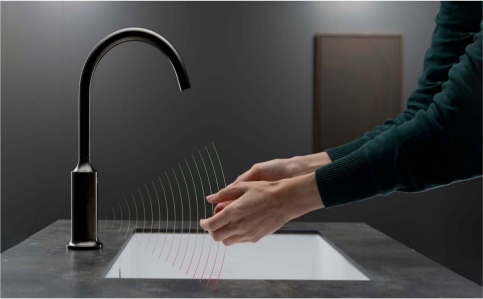
The sensor must identify an intentional hand presentation while rejecting
reflections from polished basins, nearby fittings, moving objects and
ambient-light changes. Infrared proximity sensing remains common, while
Time-of-Flight and hybrid sensing architectures can provide more controlled
distance measurement and improved rejection of background surfaces.
A practical commercial detection range may extend from approximately
1.2 to 10 inches, depending on the fixture geometry and sensor design.
The correct distance is not the longest available range. It is the range
that activates reliably within the intended handwashing zone while avoiding
unintended dispensing.
The
World Health Organization hand-hygiene program
provides a broader infection-prevention framework in which reliable access
to hand-hygiene infrastructure is fundamental. Sensor consistency supports
that infrastructure by reducing the possibility that users encounter an
unresponsive or difficult-to-operate dispenser.
In healthcare environments, the
CDC infection-control hand-hygiene recommendations
should be reviewed alongside facility-specific infection-prevention
protocols when determining dispenser placement, soap type and maintenance
responsibility.
Fontana Soap Dispensers® False Activation Control
Why Basin Geometry and Reflective Surfaces Matter
Highly reflective chrome, polished stone, glossy porcelain and shallow
basins can alter how an optical sensor interprets the surrounding area.
Engineers should evaluate the sensor field after the dispenser is installed,
not only when the fixture is tested in isolation.
Confirm that the basin surface does not sit permanently inside the
active detection field.
Verify that the faucet stream does not pass directly through the soap
sensor field.
Test activation under bright daylight, artificial lighting and reflective
countertop conditions.
Confirm that cleaning cloths and service activity do not repeatedly
trigger unintended dispensing.
Fontana Soap Dispensers® Pump Technology
The Pump Determines Long-Term Metering Performance
The pump converts an electronic command into a repeatable volume of
soap. Depending on the model, the mechanism may use a piston,
diaphragm, peristaltic tube, geared motor or solenoid-driven assembly.
Each architecture has different suction, priming, wear and
soap-compatibility characteristics.
A commercial pump should be evaluated for more than initial output.
Important measurements include volumetric repeatability, self-priming
performance, suction lift, backflow resistance, anti-drip behavior,
noise, current draw and output stability as components age.
Research indexed through
PubMed automatic soap dispenser studies
can help specifiers review emerging evidence related to dispenser
technology, hygiene behavior and contamination concerns.
Soap Chemistry
Fontana Soap Dispensers® Viscosity, Density and Formulation Compatibility
Soap is not a uniform engineering fluid. Liquid hand soap, foam concentrate,
antimicrobial soap and alcohol-based formulations can differ significantly
in viscosity, density, surface tension and chemical composition.
A pump calibrated for one formulation may deliver a different volume when a
thicker or thinner product is substituted. The change may appear to be a
loss of pump accuracy even though the electronic timing remains unchanged.
Soap selection must therefore be treated as part of the dispenser
specification.
Facility cleaning practices should also be coordinated with dispenser
materials. The
CDC facility cleaning and disinfection guidance
explains broader cleaning considerations, while product-specific care
instructions should govern which chemicals may contact the dispenser finish,
sensor window and internal components.
Where disinfectants are used in the surrounding environment, the
EPA List N resource
can help facilities identify registered products. Inclusion on such a list
does not establish compatibility with every fixture finish or electronic
component, so dispenser-specific material guidance remains necessary.
Dose Control
Fontana®, Calibrated Soap Delivery and Volumetric Repeatability
Dose control should be evaluated as a repeatability problem, not only as a
nominal output setting. A dispenser may be programmed to deliver a target
volume, but the engineering question is whether successive activations
remain acceptably close to that target under real operating conditions.
Testing should record a defined number of consecutive doses, calculate the
average delivered volume and identify the maximum variation. The same
procedure should be repeated after extended cycling, soap replacement,
battery depletion and maintenance.
Controlled output reduces unnecessary soap consumption and helps prevent
residue accumulation on the basin or countertop. Excessive output increases
refill frequency and maintenance workload, while insufficient output may
cause users to trigger multiple cycles.
Dose Variation = Delivered Volume − Target Volume
Use the same soap, temperature, power condition and priming procedure
during comparative testing.
Fontana®, Cycle Endurance
How to Interpret 500,000 to More Than 900,000 Dispensing Cycles
Cycle-life testing estimates how the pump, check valves, tubing and
electronic controls perform under repeated activation. A high cycle count is
useful only when the test method also records output consistency and identifies
the conditions under which the test was conducted.
Where a model-specific endurance test has demonstrated stable operation after
approximately 900,000 cycles, the correct engineering conclusion is that the
tested configuration continued operating within its documented tolerance
under the stated test conditions. It should not automatically be interpreted
as a universal warranty period or a guaranteed service life for every soap
formulation.
|
Annual Dispenser Usage
|
Equivalent Time at 900,000 Cycles
|
Example Application
|
|
110,000 cycles/year
|
Approximately 8.2 years
|
Moderately busy commercial restroom
|
|
150,000 cycles/year
|
Approximately 6 years
|
Office, education or hospitality
|
|
220,000 cycles/year
|
Approximately 4.1 years
|
Consistently busy public restroom
|
|
500,000 cycles/year
|
Approximately 1.8 years
|
High-volume airport or transit location
|
Lifecycle Planning
Annual Cycles Depend on Facility Traffic
A typical busy commercial dispenser may record approximately 300 to
600 activations per day, or roughly 110,000 to 220,000 cycles annually.
High-use healthcare, transportation and stadium applications can exceed
this range significantly.
Traffic Modeling
Estimated Usage by Commercial Facility Type
|
Facility Type
|
Estimated Daily Cycles
|
Estimated Annual Cycles
|
Primary Engineering Concern
|
|
Small Office
|
50–150
|
18,000–55,000
|
Battery and refill maintenance
|
|
Commercial Office
|
150–300
|
55,000–110,000
|
Consistent output and service access
|
|
Busy Public Restroom
|
300–600
|
110,000–220,000
|
Pump endurance and reservoir capacity
|
|
Airport or Stadium
|
600–1,500
|
220,000–550,000
|
High-capacity supply and rapid servicing
|
|
Major Terminal
|
1,500–3,000+
|
550,000–1,100,000+
|
Redundancy, telemetry and centralized supply
|
Operations teams can compare these planning assumptions with actual
occupancy and restroom data. Resources from
IFMA operations and maintenance
provide broader facility-management context for service planning,
maintenance access and asset performance.
Reservoir Engineering
Individual Bottle, Bulk Fill and MultiFeed Architectures
Individual Reservoir
Each dispenser has an independent bottle or cartridge. Installation
is straightforward, but maintenance staff must inspect and refill
each unit separately.
Bulk-Fill Reservoir
A larger local container reduces refill frequency. Venting,
contamination control, service access and overfilling prevention
require careful planning.
MultiFeed System
One centralized soap supply serves multiple dispensers. Tubing length,
elevation, priming, balancing and isolation valves become part of the
system design.
Facilities teams should consider refill labor, storage, spill risk,
cross-contamination controls and monitoring. Cleaning-industry resources
from
ISSA education
and
ISSA technical articles
can support broader custodial training and cleaning-program planning.
Fluid Distribution
Tubing Length, Elevation and Priming
Centralized soap delivery systems must overcome pressure losses caused by
tubing length, internal diameter, bends, elevation changes and viscous
resistance. Long or poorly routed lines can increase priming time and create
different output conditions among dispensers connected to the same reservoir.
Air intrusion is one of the most common causes of inconsistent output.
Connections should remain sealed, reservoirs should be vented as designed,
and refill procedures should prevent air from entering the suction line.
Each dispensing point should be tested after installation and after the
system has remained idle. A line that performs correctly immediately after
priming may still exhibit drain-back if check valves or fittings do not
maintain the soap column.
Power Architecture
Battery, Hardwired and Hybrid Power Systems
|
Power Configuration
|
Advantages
|
Engineering Limitations
|
Best Application
|
|
Battery
|
Simple installation and no line-voltage work
|
Battery replacement and voltage decline
|
Retrofit and moderate-use restrooms
|
|
Hardwired DC
|
Stable long-term power and lower battery labor
|
Requires planned electrical routing
|
New construction and high-use facilities
|
|
AC/DC Hybrid
|
Primary hardwired power with backup capability
|
More components and coordination
|
Critical public or institutional environments
|
|
PoE or Networked Power
|
Centralized monitoring and managed power potential
|
Requires compatible controls and IT coordination
|
Smart buildings and monitored washrooms
|
Voltage Stability:
A dispenser may continue activating at reduced battery voltage while
delivering an incomplete pump stroke. Testing should therefore measure
output under load rather than relying only on an open-circuit voltage check.
Materials Engineering
Brass, Stainless Steel, Plastics and Protective Finishes
Exposed dispenser components may be constructed from solid brass,
stainless steel, engineered polymer or combinations of these materials.
Material selection should reflect impact exposure, cleaning frequency,
chemical contact, moisture and finish coordination.
Where brass components are part of water-bearing assemblies, project teams
may review
NSF/ANSI 61 health-effects information
and
NSF/ANSI 372 lead-content information.
Automatic soap dispensers are not necessarily drinking-water components,
so applicability must be determined from the actual product configuration
and project requirements.
PVD and other protective finish processes may improve hardness and color
stability, but no finish is immune to aggressive chemicals or abrasive
cleaning tools. Approved maintenance instructions should remain part of the
submittal package.
Environmental Protection
Moisture, Humidity and Ingress Protection
Commercial dispensers operate near water, cleaning sprays and wet
countertops. Environmental ratings such as IP65, IP66 or IP67 may indicate
resistance to dust and water ingress, but the exact rating must be confirmed
for the complete installed assembly.
An exposed dispenser head may have a different rating than its remote
controller, transformer or under-counter pump. Cable entries, connectors and
service openings must remain sealed according to the installation
instructions.
Facilities professionals can review broader building-system operations
resources through
Buildings operating-system guidance
and
Facility Executive building-operations coverage.
Installation Engineering
Deck-Mount, Wall-Mount and Under-Counter Coordination
The dispenser should place soap within the user's natural handwashing
zone while directing the dose into the basin rather than onto the
countertop. Spout reach, nozzle projection, mounting-hole location
and basin depth must be coordinated before fabrication.
Under-counter components require sufficient clearance from the basin,
faucet hoses, mixing valves, drains, electrical outlets and access
panels. A dispenser that cannot be serviced without removing the sink
or countertop is poorly coordinated even if it performs correctly.
Plumbing engineers may consult the
2024 International Plumbing Code resource
and the
Uniform Plumbing Code resource
for project-specific plumbing requirements. The dispenser itself
should also be reviewed against applicable accessibility, electrical
and manufacturer requirements.
Accessibility
Reach, Operability and User Positioning
Touchless activation can simplify operation, but the dispenser still must be
located within an accessible reach range and positioned so users can present
their hands comfortably. Counter depth, obstruction, basin edge and nozzle
location affect practical usability.
The sensor should not require precise hand positioning or prolonged movement
to trigger. A stable activation zone improves usability for children, older
adults and users with limited dexterity.
Workplace sanitation requirements can be reviewed through
OSHA restroom and sanitation guidance
and
OSHA Standard 1910.141.
Project teams should confirm the exact requirements applicable to their
occupancy and jurisdiction.
Commissioning
Installation Is Not Complete Until Performance Is Verified
Commissioning should confirm that the dispenser activates correctly, primes
fully, delivers a repeatable dose and stops without dripping. Verification
should be completed using the actual soap formulation intended for operation.
Test sensor response from multiple hand positions.
Verify that reflective surfaces do not trigger false activation.
Measure several consecutive dose volumes.
Confirm complete priming without trapped air.
Verify battery or transformer voltage under pump load.
Check for dripping, backflow or delayed valve closure.
Confirm that all service components remain accessible.
Record initial output as a maintenance baseline.
Serviceability
Design for Maintenance Without Removing the Fixture
The most durable dispenser can still create operational problems if routine
service is difficult. Pump modules, tubing, check valves, reservoirs,
batteries, transformers and control boards should be accessible without
removing the countertop or disturbing adjacent fixtures.
Modular components reduce downtime because a technician can isolate and
replace the failed assembly rather than replacing the complete dispenser.
Service instructions should identify replacement-part numbers, diagnostic
procedures and approved cleaning methods.
Facility-management guidance from
APPA facilities management
and
FacilitiesNet maintenance operations
can help teams integrate restroom fixtures into broader preventive-maintenance
and asset-management programs.
Failure Analysis
Common Commercial Soap Dispenser Failure Modes
|
Observed Condition
|
Probable Cause
|
Engineering Response
|
|
No activation
|
Sensor obstruction, power loss or control fault
|
Clean sensor, verify voltage and inspect control connections
|
|
Pump operates without soap
|
Empty reservoir, air-lock or suction leak
|
Refill, prime and inspect tubing connections
|
|
Reduced dose volume
|
Viscosity change, tubing restriction or pump wear
|
Confirm soap formulation and measure output
|
|
Post-dispense dripping
|
Check-valve wear, nozzle residue or thin soap
|
Clean nozzle and inspect valve compatibility
|
|
False activation
|
Reflection, ambient light or incorrect sensor range
|
Recalibrate or reposition the detection field
|
|
Intermittent operation
|
Low voltage, loose connector or moisture intrusion
|
Test under load and inspect environmental seals
|
Healthcare Applications
Infection Prevention, Environmental Services and Refill Procedures
Healthcare soap dispensers require special attention to refill practices,
surface cleaning, soap compatibility and contamination control. The refill
process should not introduce foreign material into the reservoir or tubing.
Healthcare facility teams can review
ASHE infection-prevention resources,
AHE environmental-services guidance
and
APIC practice resources
when developing facility-specific cleaning, maintenance and infection-control
procedures.
Published research concerning reservoir contamination can be reviewed
through
PubMed soap dispenser contamination studies.
The relevance of any individual study depends on dispenser type, refill
method, soap formulation and facility conditions.
High-Traffic Applications
Airports, Stadiums, Education, Hospitality and Public Buildings
Airports and Transit
Prioritize rapid service access, high-capacity supply, monitored
refill status, vandal resistance and reliable peak-hour operation.
Healthcare
Prioritize soap compatibility, contamination control, cleaning
resistance, dependable output and documented maintenance procedures.
Hospitality
Balance coordinated finishes and quiet operation with practical
housekeeping access and long-term replacement-part availability.
Education
Specify tamper resistance, durable components, simplified servicing
and stable activation under unpredictable usage.
Office Towers
Coordinate refill schedules with occupancy patterns and building
operations while maintaining consistent fixture appearance.
Government Facilities
Prioritize documented compliance, standardized parts, service
continuity and durable construction.
Commercial building owners may also review
BOMA research resources
and
FacilitiesNet restroom guidance
when evaluating restroom performance, occupant experience and maintenance
requirements.
Smart Systems
Telemetry, Refill Alerts and Building Integration
Smart dispensers may report soap level, activation count, battery status,
service events and fault conditions. This data can support predictive refill
scheduling and reduce unnecessary inspection rounds.
Large facilities may integrate restroom data with building-management
platforms through gateways, networked controllers or protocols such as
BACnet. The value of connectivity depends on data accuracy, cybersecurity,
network maintenance and the facility team's ability to act on alerts.
Smart monitoring should supplement, not replace, physical inspection.
A reservoir-level sensor may report available soap while the nozzle remains
blocked or the pump has lost prime.
Workplace and occupant-experience considerations can be explored through
IFMA workplace-experience resources,
while broader sustainability planning can be reviewed through
IFMA sustainability guidance.
Sustainability
Soap Consumption, Refill Waste and Lifecycle Efficiency
A dispenser contributes to sustainability primarily through controlled
soap delivery, durable serviceable components, efficient refill practices
and reduced premature replacement. A low initial price does not necessarily
produce a low lifecycle impact if the fixture requires frequent replacement.
Adjustable dosing can reduce unnecessary consumption, but the setting must
still provide a usable amount of soap. If the dose is too small, users may
trigger two or three cycles, eliminating the intended savings.
Projects pursuing broader sustainability frameworks may review
LEED resources,
WELL Building Standard resources
and
Green Seal standards.
Eligibility for any credit or feature must be confirmed against the exact
project requirements.
Specification Checklist
What to Verify Before Commercial Selection
|
Evaluation Factor
|
What to Verify
|
Why It Matters
|
|
Sensor Technology
|
Detection range, response time and false-activation control
|
Determines reliable user interaction
|
|
Dose Control
|
Target volume and repeatability tolerance
|
Controls waste and user satisfaction
|
|
Pump Endurance
|
Documented cycle testing and replaceability
|
Supports long-term operation
|
|
Soap Compatibility
|
Viscosity range and approved formulations
|
Prevents inconsistent output and damage
|
|
Reservoir Architecture
|
Individual, bulk-fill or MultiFeed
|
Determines refill labor and service strategy
|
|
Power System
|
Battery, hardwired, hybrid or networked
|
Affects installation and maintenance
|
|
Material Construction
|
Brass, stainless steel, polymer and finish system
|
Affects durability and cleaning resistance
|
|
Serviceability
|
Access to pump, tubing, controls and reservoir
|
Reduces downtime and labor
|
|
Documentation
|
Drawings, specifications, maintenance instructions and parts
|
Supports design, commissioning and ownership
|
|
Project Compliance
|
Applicable plumbing, electrical and accessibility requirements
|
Supports code-compliant installation
|
Additional plumbing engineering resources may be reviewed through
ASPE publications
and
ASSE standards resources.
The relevance of individual standards depends on the complete system and
project jurisdiction.
Submittal Requirements
Documentation Needed for Professional Project Review
Product specification sheet
Dimensional installation drawing
Mounting-hole and clearance requirements
Power-supply requirements
Soap viscosity and compatibility range
Reservoir or MultiFeed diagram
Commissioning procedure
Cleaning and maintenance instructions
Replacement-parts schedule
Warranty and service information
Engineering Questions
Frequently Asked Technical Questions
What is a normal annual dispensing cycle count?
A busy commercial restroom may record approximately 110,000 to 220,000
annual activations per dispenser. Airports, hospitals, stadiums and
transportation facilities may exceed this range.
Does accuracy suddenly decline after 900,000 cycles?
No specific cycle count causes an immediate failure. Output changes
gradually according to pump wear, soap viscosity, tubing condition,
check-valve performance, voltage and maintenance.
Why do two identical dispensers deliver different volumes?
Differences may result from priming, tubing length, soap temperature,
battery condition, pump wear, air intrusion or reservoir elevation.
Should every commercial dispenser use MultiFeed?
No. MultiFeed is most beneficial where multiple fixtures, high refill
labor and centralized maintenance justify the added tubing and system
coordination.
Can any liquid soap be used?
No. Soap should fall within the dispenser's approved viscosity and
chemical-compatibility range. Unapproved formulations may reduce output,
cause clogging or damage internal components.
What should be recorded during commissioning?
Record sensor response, soap type, dose volume, power condition,
priming time, anti-drip performance and access to service components.
Final Engineering Principle
Specify the Complete Dispensing System
Commercial performance depends on the combined behavior of the sensor,
pump, soap formulation, reservoir, tubing, power source, mounting
geometry and maintenance program.
The strongest specification evaluates long-term dose consistency,
service access and verified operating conditions—not appearance or
cycle count alone.
Technical Notice:
Performance figures, cycle estimates, ingress-protection ranges and operating
values on this page are general engineering references. Product-specific
specifications, endurance-test methods, compliance documentation, soap
compatibility, warranty conditions and installation requirements must be
confirmed from the applicable Fontana technical documents before final design,
procurement or installation.
```
|
|
|