

Fontana Touchless Faucets WELL Hospitality Restroom Technologies
Hospitality Restrooms Make a Difference Beyond Plumbing Performance. They are critical in the guest’s perception of cleanliness, comfort, accessibility, operational quality and overall integrity of the property. Hotels, resorts, convention centers, restaurants, spas and mixed-use hospitality developments require lavatory systems that perform consistently through extremely variable occupancy cycles, from quiet overnight periods to intense ballroom, conference, restaurant and check-in surges.
So for architects, plumbing engineers, interior designers, sustainability consultants, and facility operators, the goal isn’t just to choose a pretty tap. The objective is to create a coordinated handwashing ecosystem that enhances human health while reducing superfluous water use, cleaning effort, service disruption and life-cycle hazard.
Well-designed commercial touchless tap systems can help accomplish this goal by removing the need to engage handles, controlling the duration of activation and supporting a consistent guest experience. They also can be part of project strategies that involve the WELL Building Standard, especially when combined with water-quality management, accessible handwashing stations, cleaning protocols, and documented facility operations.
WELL certification is a project level process, not a claim that should automatically be made to a single tap. Restroom fixtures should be described as WELL-aligned components whose contribution needs to be evaluated within the complete project scorecard, documentation package, and performance-verification process.

Why Hospitality Restrooms Are Important to WELL-Oriented Design
The WELL framework assesses strategies for buildings and operations that influence occupant health and well-being across ten concepts, including Water, Materials, and Community, and other human-centered performance areas. In the hospitality sector, lavatory design is directly linked to access to handwashing, water quality, inclusive design, cleaning efficacy, and the confidence of occupants.
The Centers for Disease Control and Prevention says that in most everyday situations, washing with soap and water is the best way to get rid of germs. Touchless technology doesn’t replace good hand-washing practices; instead it helps create an environment where water and soap are available with less physical contact.
A hospitality hand washing station, that is so successful, should be considered as a complete assembly consisting of:
Faucet with sensors
Easy to use soap dispenser or automatic
Lavatory basin drainage geometry
Tempered water delivery system
Available clearance and reach ranges
Hand drying facility
Electrical or battery power systems
Access to service stops & isolation
Cleaning and maintenance activities
Read MoreShow Less
One can suffer in performance at the hands of another component. For example, a very efficient tap may still create a poor guest experience if the basin causes splash, the soap sensor is in the wrong position, the detection range produces false activation or maintenance personnel cannot reach the solenoid without removing the countertop.


Translating WELL Objectives to AEC Specifications
Touchless Activation and User-Focused Hygiene
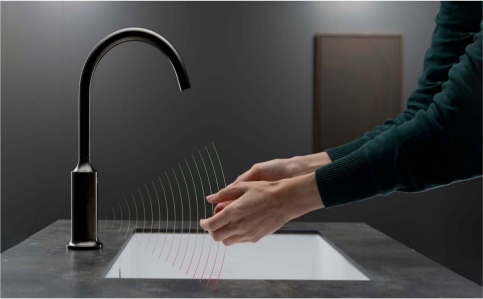
Infrared and other presence sensing technologies should activate the water only when hands are in the desired detection zone. The sensor has to detect a wide spectrum of skin colours and hand positions, jewellery, sleeves and ambient light conditions without uncontrolled activation for hospitality applications .
Specifications should include adjustable or self-calibrating detection, maximum run time, automatic shutoff, false-trigger resistance and post-installation calibration. If the tap and soap dispenser are installed as independent units, their detection zones should be coordinated to avoid cross-activation.
Architects and plumbing consultants can work with the selected tap finish, countertop module, refill method, reservoir location and maintenance-access approach to coordinate automatic soap dispensing solutions.
Water-efficient without sacrificing function
Actual water use is not determined by flow rate alone. The total demand is affected by flow rate, activation duration, sensor accuracy, pressure conditions, outlet design and the number of unintended cycles.
EPA WaterSense-labeled private lavatory faucets use no more than 1.5 gallons per minute and offer at least a 30 percent flow reduction when compared to a 2.2-gallon-per-minute conventional reference. But faucets in public restrooms are not yet eligible for the WaterSense label. Therefore, public hospitality lavatory requirements need to distinguish between using WaterSense as an efficiency benchmark and claiming formal label eligibility.
In many hotel restrooms, especially in public areas, project teams often look at lower-flow fixtures, timed on, and pressure compensating control. The final choice should provide sufficient rinsing, minimise splash, and meet the applicable plumbing code and authority having jurisdiction.


Coordinating accessible restrooms
Although automatic operation eliminates the gripping, pinching, twisting and force required by conventional tap handles, a touchless tap alone does not make the entire lavatory installation accessible.
The basin, counter, faucet sensor, soap dispenser, mirror, piping protection, knee clearance, toe clearance and clear floor space must all be coordinated as one complete accessible station. Required knee and toe space must extend far enough to allow for reaching to faucet controls, soap dispensers and other operable parts, the U.S. Access Board says.
Read MoreShow Less
Design teams should use ADA touchless washbasin tap planning resources as a starting point while verifying the adopted accessibility code, ICC A117.1 provisions and project-specific jurisdictional requirements.


Materials and drinking-water contact
Where applicable to the project and jurisdiction, submittals should show compliance with standards such as:
Plumbing supply fittings ASME A112.18.1/CSA B125.1
NSF/ANSI/CAN 61 Drinking water system component health effects
NSF/ANSI/CAN 372 Lead Content Requirements
Read MoreShow Less
ASME A112.18.1/CSA B125.1 Plumbing supply fittings, including lavatory fittings NSF/ANSI/CAN 61 Health effects of materials and products in contact with drinking water NSF/ANSI/CAN 372 offers a means to assess compliance with lead content.
The compliance should be checked against the real submitted model and configuration and not against a product family or marketing description.


Touchless Faucet Specification Matrix Hotel & Hospitality
| AEC Criterion Required Hospitality RequirementVerification Approach | ||
|---|---|---|
| Sensor performance Detection with adjustable or self-calibration false trigger resistanceFunctional mock-up and commissioning test | ||
| Flow control Pressure compensating outlet matched to local codesCertified Flow Rate Data and Field Measurement | ||
| Runtime safetyAutomatic timeout and closed position failure responseData from the manufacturer and witnessed testing | ||
| Power System Hardwired, battery or hybrid power depending on duty cycleProduct submittal and electrical drawings | ||
| Serviceability Accessible solenoid, filter, battery, mixing valve, isolation stops Maintenance-access review | ||
| Accessibility Sensor, basin, dispenser and clearances coordinated as one station ADA and ICC A117.1 drawing review | ||
| MaterialsApplicable ASME, NSF 61 and NSF 372 documentationThird-party certificate or listing | ||
| Finish durability Finish resistant to repeated cleaning and hospitality chemicalsCleaning Products Compatibility Statement | ||
| Integration of controls Optional activation Monitoring of battery or faultManages story and point schedule | ||
| Closeout Commissioning and turnover documentation, Calibration records, spare parts, O&M manuals, and staff training |


Hospitality Case in Point: Public Restrooms in Convention Hotels
For instance, a typical 300-room city convention hotel has 20 public toilet facilities scattered around the lobby, meeting rooms, restaurant and ballroom. The facilities team logs about 1,800 tap activations daily, with an average commanded run time of 20 seconds.
The following chart compares calculated demand at three levels of flow. This is a design illustration and does not guarantee actual savings.
Annual Water-Demand Comparison Sample
| Scenario Flow Rate FixturesCalculated Yearly Demand Calculated Daily DemandAnnual Reduction v. 2.2 gpm | ||
|---|---|---|
| Conventional reference 2.2 gpm 1,320 gallons 481,800 gallons Base case | ||
| High efficiency Reference 1.5 gpm 900 gallons 328,500 gallons 153,300 gallons | ||
| Low-flow public restroom plan 0.5 gpm 300 gallons 109,500 gallons 372,300 gallons |
Working out:
Daily demand = number of activations x duration of activation / 60 x tap flow rate
Read MoreShow Less
The comparison suggests that the 0.5 gpm strategy would use approximately 77 percent less water than the 2.2 gpm reference under the same assumptions of activation. Actual performance will vary based on occupancy, water pressure, sensor operation, guest usage, cleaning cycles and maintenance condition.
This case also demonstrates the importance of sensor accuracy. Even at a half-gallon per minute, a poorly calibrated tap that opens for only 200 unnecessary 20-second activations per day will use an extra 12,167 gallons per year. Thus the activation of the sensor is an action of water management measurable, not a small adaptation of an installation.


Power, Thermal Control, and Maintenance Planning.
In hospitality restrooms with high occupancy, hardwired power can be advantageous where electrical infrastructure exists and access for battery replacement is limited. Battery-operated faucets can make the retrofitting easier, while hybrid systems can keep running. The proper choice depends upon expected cycles, access conditions, labour cost, outage strategy and operator’s preventive-maintenance program.
Coordination of tempered-water delivery with the building’s domestic hot-water design is also required. Engineers should evaluate the chosen mixing scheme, maximum outlet temperature, pressure variation, recirculation design, stagnation risk and local scald protection needs.
Maintenance access should be considered during design development, not after the stone countertop, millwork and under-counter enclosure are installed. Water should be isolatable by service personnel and filters, solenoids, batteries, wiring and mixing components should be accessible without destructive work.
A hospitality fixture specification should also call for:
Sensor calibration, initial
Faucet and washbasin alignment confirmed
Design pressure splash test
Flow verification measured
Timeout test
Dose adjustment of soap dispenser (b)
Testing of battery or power failure
Training and Maintenance Staff
Spare filters, outlets, seals, solenoids
Approved for cleaning-agent documentation


Restroom Technology: A Coordinated Approach
Fontana Touchless Faucets WELL hospitality lavatory technologies perform best when viewed as part of an integrated architectural and engineering system. The tap should coordinate with the sink. Soap dispenser should be compatible with cleaning workflow. The power supply must be compatible with the electrical design. The tempered-water system must function in a plumbing-safe manner, and all components must be accessible to guests and maintenance personnel.
Read MoreShow Less
The best spec for AEC teams is not the one with the longest product description. This is the one that clearly defines the requirements for measurable flow, sensing, power, materials, accessibility, serviceability, commissioning and documentation.
A combination of touchless operation and accessible planning, verified plumbing standards, water demand management, maintainable components and WELL-oriented operational practices can provide hospitality properties with restrooms that are cleaner, perform better and support guest health and long term facility value.