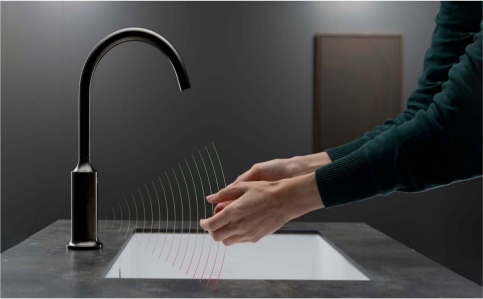


Fontana Touchless Faucets WELL Water Quality Touchless Faucets
Water quality in a high performance building is not defined by a single fixture. It is a result of source-water conditions, distribution-system design, treatment, temperature control, plumbing materials, commissioning, testing, and ongoing facility operations. When properly specified as part of the building water-management strategy and not treated as isolated restroom accessories, touchless faucets can support hygiene, accessibility, controlled water use, and fixture standardisation within that system.
The question for architects, plumbing engineers, interior designers, contractors, commissioning providers and facility teams isn’t whether a tap operates automatically. A more practical question is whether the entire tap assembly satisfies the water-quality, accessibility, performance, and maintainability goals of the project.
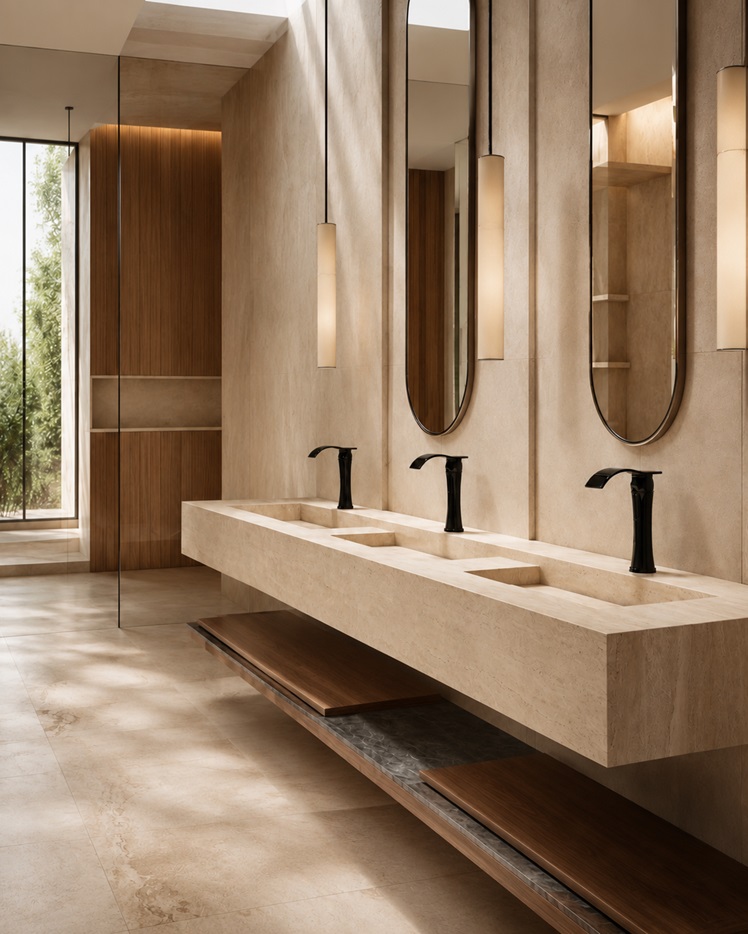
Well Water Connection to Touchless Faucets
The WELL Building Standard is a certification for buildings and organisations, not individual faucets. A product should not be labelled “WELL certified” unless a product-assessment program explicitly permits the use of that claim. But, with the right choice of commercial touchless faucets for AEC restroom specifications, you can support a project strategy tied to the WELL v2 Water concept, which covers water quality, contaminant management, testing, treatment and occupant access.
Read MoreShow Less
WELL Essential Water Quality requirements rely on performance testing, such as total coliform bacteria and turbidity, to assess water safety. So the design team needs to look beyond the visible fixture and evaluate the conditions from the incoming service, through the building distribution system, to the terminal outlet. The tap is one controlled endpoint in a larger potable-water system, not a substitute for filtration, sampling, flushing, or risk management.


Water Quality Is a Systems Problem
Touchless operation reduces the need for occupants to grasp tap handles, but does not disinfect water or eliminate microbial risk. The CDC lists water age, temperature, sediment, biofilm and disinfectant residual as key parameters that impact Legionella growth. CDC guidance also recommends that design teams consider potential risks of low-flow and mechanically complex fixtures, such as electronic sensor faucets, when operation or maintenance allows stagnation.
Read MoreShow Less
Thus, the WELL-aligned plumbing design should incorporate sensor faucets with pipe sizing, branch length, hot-water circulation, point-of-use mixing, flushing procedures, and the water-management program of the facility. ANSI/ASHRAE Standard 188 sets forth minimum requirements for the management of the risk of legionellosis associated with building water systems and the CDC building water management toolkit offers an operational framework for owners and facility managers.


Priorities of Touchless Faucet Specification
A good Division 22 tap spec is more than just looks, finishes and how it’s mounted. Basis-of-design language shall specify acceptable sensing technology, detection range, automatic shutoff logic, maximum run time, power source, flow control, mixing arrangement, service access, and required third-party certifications.
Safety of materials is an important aspect. Products to be used in contact with potable water shall be tested for compliance with health-effects and lead-content requirements of the project as applicable. NSF says faucets and plumbing products used for drinking water applications should be tested and certified to NSF/ANSI/CAN 61. NSF/ANSI/CAN 372 provides a consistent approach to evaluating and verifying compliance with lead content requirements. Plumbing supply fittings should also be compared to the latest edition of ASME A112.18.1/CSA B125.1.
Read MoreShow Less
The design team should request listing documentation specific to the model rather than relying on general manufacturer statements. Flow rates, electrical requirements and code compliance certifications may vary from model to model within the same collection.
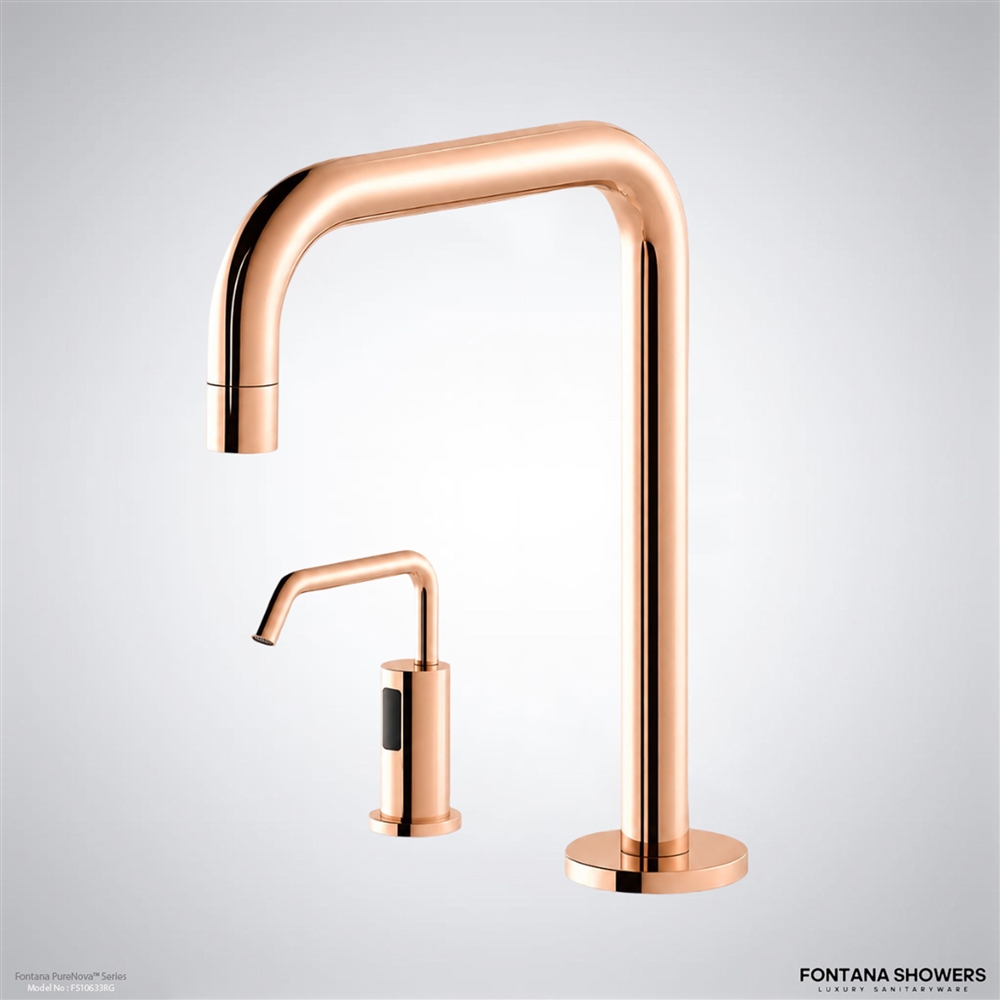

Designing Accessible and Inclusive Restrooms
You can use sensor activation to cut down on manual operation, but still need the whole lavatory setup to get to. Clear floor space, forward approach, knee and toe clearance, reach ranges, counter height, protected piping, basin depth and tap placement must all be coordinated.
The U.S. Access Board indicates that at least one compliant lavatory is required when lavatories are provided in each accessible toilet or bathing room. Accessible sinks and lavatories shall also comply with the applicable clearance and approach requirements. Model-specific dimensions and installation instructions should be reviewed along with the Access Board’s guidance for ADA-compliant lavatories and sinks.
Read MoreShow Less
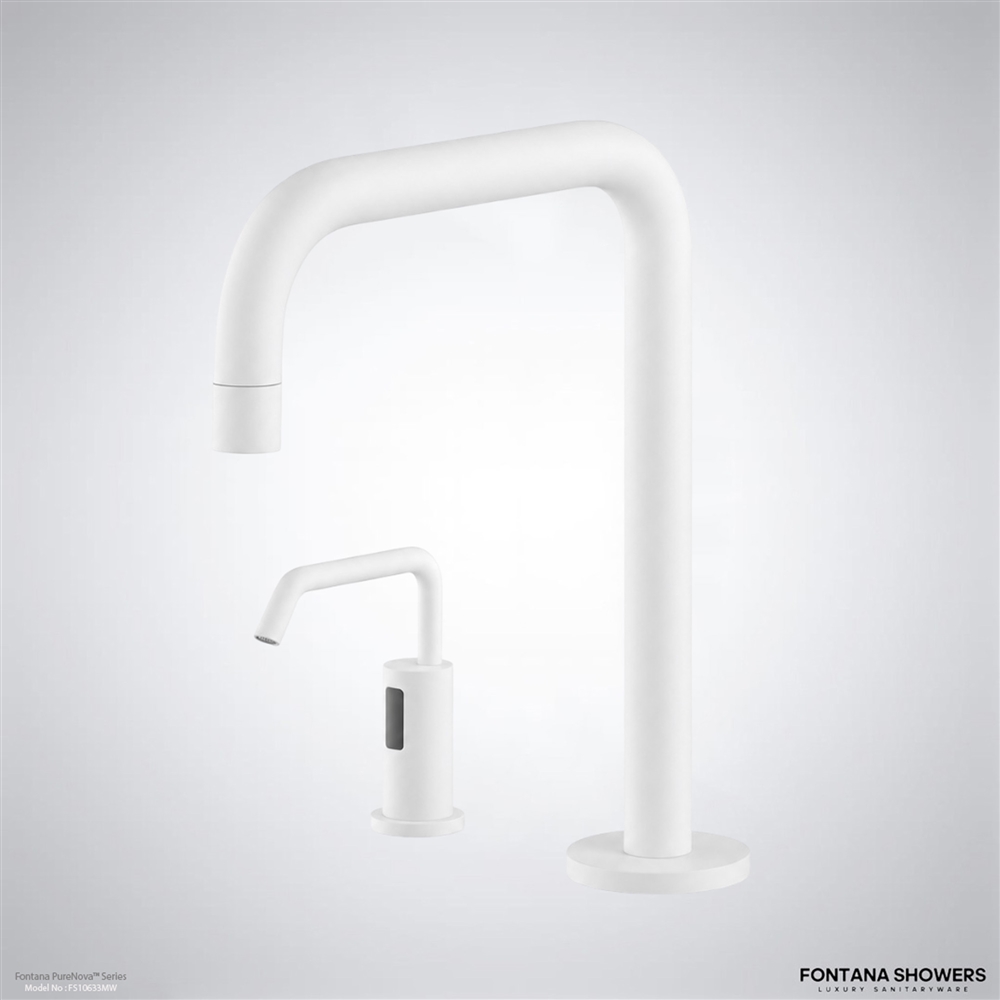
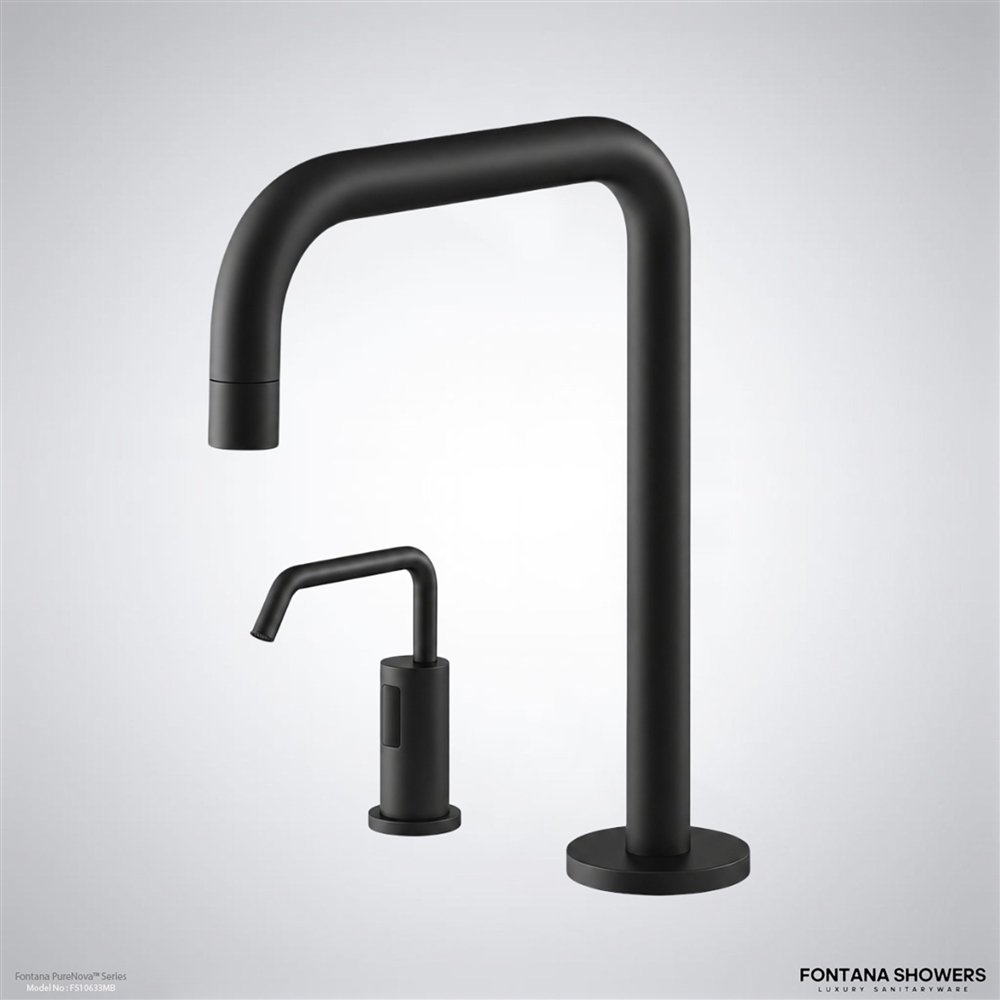
Fontana's ADA touchless washbasin tap collection can serve as a starting point for product navigation for design teams, pending full submittal and accessibility confirmation.


Touchless Faucet Specification Chart Reference
| AEC criterion | Recommended design response | Evidence Needed |
|---|---|---|
| Water Quality | Reduce dead legs, excessive branch volume, and low-use piping | Riser diagrams, branch calculations and flush plan |
| Material health | Require applicable potable-water and lead-content certifications | NSF/ANSI/CAN 61 and 372 documents |
| Fixture performance | • Specify flow rate, sensor range, run time and shutoff behaviour | Functional Test & Certified Data Sheet |
| Accessibility | Coordinate tap, basin, counter, clearances and protected piping | Accessibility Review And Enlarged Restroom Plans |
| Thermal Safety | Position mixing control to minimise scalding and stagnant mixed-water volume | Mixing valve details and temperature testing |
| Maintainability | Access to batteries, transformers, solenoids, strainers and aerators | Access diagram and spare parts schedule O&M manual |
| Water efficiency | Select flow control appropriate for the project without compromising handwashing | Design Basis Narrative and Flow Testing |
| Commissioning | Normal use, power loss and abnormal activation operation | Functional performance testing report |
The EPA says WaterSense-labeled products that are independently certified use at least 20 percent less water than standard products and perform as well or better. However, for commercial projects, specifiers should verify that the exact product type and model is eligible for WaterSense labelling, instead of using 'WaterSense' as a generic synonym for low flow.
Read MoreShow Less
EPA WaterSense commercial building guidance and WaterSense at Work resources can help owners link fixture selection to overall water, energy, and operating-cost management.


Sample AEC case citation
Consider a multi-story office retrofit with heavily used lobby restrooms and lightly used tenant-floor restrooms. A weak approach would be to replace each manual tap with the same model sensor and consider the project complete after installation.
A more robust approach would involve mapping fixture-use patterns, identifying distal outlets, calculating branch volumes, selecting appropriate power and mixing configurations, and establishing separate commissioning and flushing protocols for high-use and low-use zones.
During functional testing, the commissioning provider would check:
Sensor detection and reset range
False or unintentional activation
Maximum operation time and Automatic power off
Outlet temperature and delivered flow rate
Restoration of power operation
Leakage at the fittings and solenoid valves
Accessibility of strainers, aerators, power components
The owner would add aerator cleaning, strainer inspection, sensor calibration, battery replacement and flushing of low-use outlets to the preventive maintenance program. This process connects touchless technology to measurable operational controls instead of just a hygiene story.
Read MoreShow Less
Where a coordinated handwashing station is needed, designers can pair sensor faucets with commercial automatic soap dispensers. Coordinate tap and dispenser activation zones with standard basin shape, splash control, accessible reach, access for refilling and below-counter maintenance space.


Commissioning & Continuous Validation
Before occupancy, representative faucets of each type installed shall be functionally tested under normal and abnormal conditions. The project team should log flow, temperature, sensor response, timeout, power-loss behaviour, leakage and access for servicing.
Water-quality sampling must be performed according to the project’s WELL verification plan, applicable regulations, and laboratory protocols. The sampling results must be coordinated with the building’s flushing and water management procedures so that they accurately reflect the operating conditions.
Read MoreShow Less
After turnover, facility teams should monitor temperature, disinfectant residual, pH and locations where water moves slowly as required by the building water-management program. CDC guidance stresses the need to monitor these parameters and to correct conditions that could increase the risk of Legionella growth or spread.


FontanaTouchlessFaucets WELL Water Quality Touchless Faucets should be specified as engineered end use devices as a part of an overall building water quality system. Fixtures perform best when architects, engineers, contractors, commissioning providers, and owners coordinate fixture selection with material certification, accessibility, thermal safety, water efficiency, branch design, performance testing, and long-term maintenance.
Read MoreShow Less
The result is more than a hands-free commercial bathroom. It’s a more controlled, serviceable and health-focused plumbing installation, one that can support WELL objectives and also meet the practical operating demands of workplace, hospitality, healthcare, education, retail and institutional buildings.