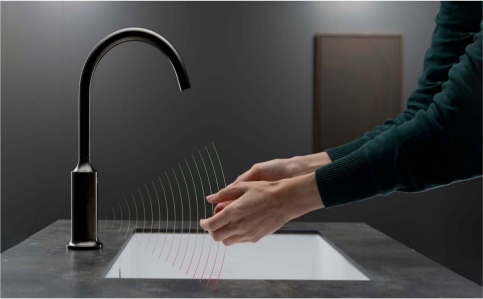
Optical Detection Engineering
Automatic Soap Dispenser Sensor Technology & Activation Engineering
A technical guide to infrared detection, Time-of-Flight sensing,
hybrid algorithms, activation timing, reflective surfaces, false-trigger
control, commissioning and long-term sensor reliability.
Engineering Overview
The Sensor Controls the Entire Dispensing Sequence
The sensor is the first active control element inside an automatic
soap dispensing system. It must detect an intentional hand position,
reject background reflections, issue a stable activation command and
reset without producing duplicate or unintended doses.
Fontana Soap Dispensers
®
should therefore be evaluated as optical, electronic and mechanical
systems rather than simple motion-activated accessories. Detection
performance depends on sensor architecture, mounting geometry,
counter reflectivity, ambient light, moisture, controller logic,
pump timing and power condition.
A successful activation occurs only when the complete sequence works:
the hand is detected, the signal is validated, the pump starts, soap
reaches the outlet and the controller resets without re-triggering.
The
CDC handwashing guidance
recognizes washing with soap and clean running water as a primary
hand-hygiene practice. Commercial sensor reliability helps facilities
maintain dependable soap access at the point of use.
Activation Chain
Four Stages of Touchless Soap Delivery
Detect
Identify an object within the intended activation zone
Validate
Reject noise, reflections and unstable signals
Dispense
Command the pump for a calibrated delivery cycle
Reset
Prevent repeated activation until the hand is removed
Detection Fundamentals
How an Automatic Soap Dispenser Detects a Hand
An optical dispenser usually emits infrared energy toward a defined sensing
zone. When a hand enters that zone, some of the emitted signal returns to a
receiver. The controller evaluates the returned signal and determines
whether the change represents an intentional activation.
The controller does not simply respond whenever infrared energy is present.
It may compare signal strength, distance, duration, rate of change and
background conditions before authorizing the pump.
Fontana Automatic Soap Dispensers
®
may use infrared, Time-of-Flight or hybrid detection depending on model and
application. The selected architecture should be verified in the applicable
technical data.
Sensor Architectures
Infrared, Time-of-Flight and Hybrid Detection
|
Sensor Architecture
|
Operating Principle
|
Primary Strength
|
Primary Engineering Concern
|
|
Infrared Reflective
|
Evaluates returned infrared intensity
|
Compact and widely proven
|
Reflective backgrounds and surface color
|
|
Time-of-Flight
|
Measures signal travel time to estimate distance
|
Controlled distance-based detection
|
Window cleanliness and optical alignment
|
|
Hybrid IR and ToF
|
Combines reflection and distance information
|
Improved environmental discrimination
|
Controller complexity and calibration
|
|
Capacitive or Alternate Sensing
|
Detects changes in an electrical or alternate sensing field
|
Reduced reliance on reflected light
|
Model-specific range and enclosure behavior
|
Selection Principle
Sensor Type Alone Does Not Guarantee Performance
The strongest sensor can perform poorly when the activation zone,
basin, countertop, sensor window or controller threshold is incorrectly
coordinated.
Infrared Reflection
How Reflective Infrared Detection Works
A reflective infrared sensor contains an emitter and receiver. The emitter
produces infrared light, while the receiver measures energy reflected by an
object inside the sensor field.
The amount of returned energy depends on distance, angle, hand position,
skin reflectivity, clothing, moisture and background materials. A nearby
bright surface may return more energy than a darker hand farther away.
The controller must distinguish between the stable background and a new
object entering the activation zone. Adaptive background measurement can
improve performance when the installed environment remains within the
controller's adjustment range.
Engineering Requirement:
Reflective infrared systems should be commissioned above the actual basin
and counter rather than calibrated only in open air.
Time-of-Flight Sensing
Measuring Distance Instead of Reflection Strength Alone
Time-of-Flight sensing estimates object distance by measuring how long a
transmitted optical signal takes to return to the sensor. This can provide
more direct distance information than a system relying primarily on returned
intensity.
A ToF controller can define an activation window and reject objects outside
that distance. This can be valuable where nearby countertops, basin walls or
standing water create strong reflections.
ToF performance still depends on optical-window cleanliness, signal quality,
alignment, environmental light and the controller's confidence thresholds.
It should not be described as immune to every reflective condition.
Fontana Sensor Technology
®
using ToF should be verified for the scheduled detection range, response
time, environmental limits and installation geometry.
Hybrid Detection
Combining ToF and Infrared Signal Validation
A hybrid sensor can evaluate more than one property of the returned signal.
For example, the controller may compare measured distance with reflected
intensity, signal stability and movement into the activation zone.
This multi-variable approach can help distinguish an intentional hand from
background reflections, soap residue, moving water or adjacent equipment.
Hybrid sensing does not remove the need for commissioning. Thresholds that
are too permissive can still cause false activation, while thresholds that
are too restrictive can reject valid users.
Selected Fontana Touchless Soap Dispensers
®
may use hybrid detection where project conditions demand greater optical
stability.
Detection Geometry
Field of View, Detection Cone and Activation Zone
The activation zone is a three-dimensional region rather than one fixed
point. Its shape is influenced by emitter optics, receiver optics, sensor
recess, mounting angle and controller threshold.
A wide field can make hand placement intuitive but may also detect the basin
rim, faucet stream or adjacent activity. A narrow field reduces background
exposure but requires more precise hand positioning.
|
Field Characteristic
|
User Effect
|
Engineering Risk
|
|
Wide Detection Field
|
Easy hand entry
|
Greater exposure to background objects
|
|
Narrow Detection Field
|
More precise positioning required
|
Missed activation if alignment is poor
|
|
Long Detection Range
|
Earlier activation
|
Possible response to basin or counter surfaces
|
|
Short Detection Range
|
Hand must approach closely
|
Reduced intuitive use and possible contact
|
Detection Range
Selecting and Calibrating the Activation Distance
Selected Fontana Commercial Soap Dispensers
®
may support adjustable detection ranges within approximately 1.2 to
10 inches, depending on model, sensor architecture and installation.
The optimal range should allow the user to position a hand naturally beneath
the outlet while keeping the background outside the active zone.
Range should not be increased simply because some users initially miss the
sensor. The underlying cause may be incorrect nozzle position, poor visual
cueing, an obstructed window or an activation field directed away from the
expected hand path.
Adjustment Warning:
Excessive range can create continuous activation when the basin, drain,
counter edge or standing water enters the sensor field.
Response Time
Detection Speed Versus Time-to-Soap
Sensor response time is the interval between valid hand detection and the
controller's activation command. Time-to-soap includes additional delays
from pump startup, tubing elasticity, priming condition and fluid travel.
A sensor response target below approximately 300 milliseconds can provide
immediate feedback, but the complete user experience should be measured at
the nozzle.
Time-to-Soap = Detection + Validation + Pump Startup + Fluid Travel
Measure the complete sequence under normal installed conditions.
Reducing the validation interval too aggressively can make the system more
responsive but less resistant to electrical noise and brief reflections.
The controller must balance speed with signal confidence.
False Activation
What Causes a Dispenser to Activate Without a Hand?
False activation occurs when the controller accepts an unintended optical or
electrical condition as a valid hand. Common causes include reflective basin
surfaces, moving water, direct sunlight, cleaning tools, condensation,
adjacent sensor signals and unstable power.
A single false dose may appear minor, but repeated false activation increases
soap consumption, drains batteries, soils the basin and can empty a reservoir
before the expected refill interval.
Fontana Touchless Systems
®
should use controlled detection thresholds, signal filtering, reset logic and
appropriate mounting geometry to reduce ghost triggering.
False-Trigger Sources
Environmental and Installation Causes
|
False-Trigger Source
|
Signal Effect
|
Engineering Response
|
|
Polished Countertop
|
Strong stable or changing reflection
|
Reduce range, adjust angle or use distance validation
|
|
Standing Water
|
Moving reflective surface within the field
|
Reposition field and verify basin drainage
|
|
Direct Sunlight
|
Elevated optical background or receiver saturation
|
Use ambient-light compensation and protected placement
|
|
Cleaning Cloth or Mop
|
Temporary object enters activation field
|
Use service mode or temporary sensor lockout
|
|
Condensation
|
Light scattering across sensor window
|
Dry window and improve environmental protection
|
|
Electrical Noise
|
Unstable controller input
|
Inspect grounding, power and cable separation
|
|
Adjacent Dispenser
|
Optical cross-talk or overlapping fields
|
Adjust spacing, timing or sensor orientation
|
Reflective Materials
Chrome, Polished Stone, Porcelain and Standing Water
Highly reflective materials can return optical energy directly toward the
receiver. The risk is highest when the sensor axis intersects the countertop,
basin wall, drain cover or faucet finish.
Polished granite and quartz may create directional reflections that change
as the user's hand moves. Chrome drains and faucets can behave like mirrors
at certain angles.
Porcelain and solid-surface basins can produce diffuse or specular reflection
depending on finish, curvature and moisture. Water adds a moving reflective
layer that can change the apparent background.
Design Practice:
Review the sensor field in plan and section so the direct optical path does
not terminate on polished hardware or the basin's wettest surface.
Surface Color
Black, White and Low-Reflectivity Objects
Dark materials often return less infrared energy than light materials.
Reflective-intensity sensors may therefore detect a light object at a longer
distance than a dark object.
A hand wearing a dark glove may produce a weaker return than an uncovered
hand at the same distance. A highly reflective white basin can create a
stronger background return than the user's hand.
Distance-based and hybrid systems can reduce reliance on intensity alone, but
acceptance testing should still include bare hands, light gloves and dark
gloves where these are expected in the facility.
Ambient Light
Bright-Light Compensation and Optical Saturation
Restrooms may contain daylight, LED lighting, reflected sunlight and
illuminated mirrors. These sources can increase the optical background seen
by the sensor.
Ambient-light compensation measures or filters background energy so the
controller can identify the dispenser's own modulated signal. Excessive
light can still reduce the available signal margin or saturate the receiver.
Fontana Sensor Technology
®
should be tested under the brightest expected operating condition, including
daylight through nearby windows and illuminated mirror systems.
Signal Processing
Thresholds, Filtering and Activation Confidence
The sensor receiver converts optical energy into an electrical signal. The
controller then filters noise, compares the signal with the background and
applies an activation threshold.
A low threshold increases sensitivity but can admit noise and weak
reflections. A high threshold improves rejection but may miss dark objects,
small hands or users approaching at the edge of the field.
|
Controller Parameter
|
Purpose
|
Incorrect Setting Risk
|
|
Detection Threshold
|
Defines required signal change
|
False or missed activation
|
|
Validation Time
|
Requires signal persistence
|
Slow response or noise triggering
|
|
Background Baseline
|
Defines normal installed condition
|
Continuous activation after environmental change
|
|
Reset Threshold
|
Determines when the hand has left
|
Duplicate dispensing or failure to re-arm
|
|
Lockout Time
|
Prevents immediate repeat cycles
|
Soap waste or delayed legitimate second dose
|
Reset Logic
Preventing Multiple Doses from One Hand Placement
After dispensing, the controller should remain locked until the hand leaves
the activation zone or until a controlled reset condition is satisfied.
Without effective reset logic, a stationary hand may trigger repeated pump
cycles. Conversely, an excessively long lockout can prevent a legitimate
second activation when additional soap is required.
A reliable system distinguishes between one continuous hand placement and a
new entry after withdrawal. The reset threshold should include hysteresis so
small signal fluctuations do not rapidly switch the system on and off.
One Entry + One Validated Presence = One Dispensing Cycle
A new dose should require a confirmed reset and a new valid entry.
Cross-Talk Engineering
Preventing Interference Between Adjacent Dispensers
In multi-basin installations, adjacent optical fields may overlap or one
sensor may detect energy emitted by another unit. Cross-talk can cause
intermittent activation, missed detection or unstable background readings.
Spacing, sensor orientation, optical shielding, coded modulation and
time-separated emission can reduce interference. The appropriate method
depends on the controller architecture.
Fontana Commercial Soap Dispensers
®
should be tested with every adjacent unit powered and operating. Testing one
dispenser at a time may fail to reveal cross-talk.
Water Interaction
Preventing Faucet Flow from Activating the Soap Dispenser
A faucet stream can intersect or reflect into the soap sensor field,
particularly where the dispenser and faucet are installed too close together.
Moving water may create a changing optical return that resembles hand entry.
The soap outlet should be offset from the faucet stream while remaining
within the user's natural handwashing sequence. Sensor axes should not be
directed toward the water column or the brightest wet basin surface.
Coordinated Fontana Touchless Faucet and Soap Dispenser Sets
®
should be reviewed as one optical and hydraulic installation rather than two
independent fixtures.
Sensor Window
Optical Transmission, Protection and Surface Condition
The sensor window protects the emitter and receiver while allowing the
operating optical wavelength to pass. Its material, thickness, tint,
coating, curvature and surface finish affect signal transmission.
Scratches can scatter light, while soap film, fingerprints and mineral
deposits can reduce transmission or create secondary reflections. An
incorrect replacement window can alter the calibrated field.
The window should resist routine cleaning and expected impact without
becoming optically cloudy. Maintenance personnel should use approved
nonabrasive cleaning methods.
Cleaning Effects
Soap Film, Disinfectants and Abrasive Damage
Residue on the sensor window can cause missed activation, shortened range or
unstable triggering. The problem may be mistaken for electronic failure even
when the sensor module remains operational.
Harsh cleaners can haze polymer windows, attack seals or leave reflective
films. Abrasive pads can create fine scratches that permanently alter
optical behavior.
Cleaning teams should follow model-specific Fontana maintenance instructions
and may use broader facility-cleaning resources such as
CDC cleaning and disinfection guidance
and
ISSA education resources.
Do not polish a damaged sensor window.
Polishing can change thickness, curvature and optical transmission. Replace
the approved window or sensor assembly when required.
Moisture and Condensation
Humidity Effects on Optics and Electronics
Commercial restrooms can expose sensors to high humidity, basin splash,
steam, condensation and cleaning spray. Moisture on the external window can
scatter light, while moisture inside the enclosure can affect electronics
and connectors.
Selected Fontana sensor systems may be designed for high-humidity conditions,
potentially up to approximately 95% relative humidity depending on model and
installation. Environmental ratings must be verified from the applicable
technical sheet.
Sealed cable entries, protected connectors, gasketed enclosures and correct
installation orientation can reduce moisture entry. An IP rating applies only
to the tested component and configuration.
Ingress Protection
IP65, IP66 and IP67 Sensor Assemblies
|
Protection Level
|
General Engineering Meaning
|
Application Consideration
|
|
IP65
|
Dust-tight with protection from water jets
|
May suit splash-prone interior components when properly installed
|
|
IP66
|
Dust-tight with protection from more powerful water jets
|
Consider where stronger wash exposure is expected
|
|
IP67
|
Dust-tight with temporary immersion protection under test conditions
|
Does not permit uncontrolled installation or chemical exposure
|
Selected commercial components may fall within an IP65 to IP67 range.
Verify the exact rating of the dispenser head, sensor, controller, battery
compartment and power supply separately.
Temperature Stability
How Temperature Influences Optical and Electronic Performance
Temperature can affect emitter output, receiver sensitivity, oscillator
stability, battery voltage and condensation risk. A system calibrated at
room temperature should remain stable across its declared operating range.
Selected Fontana automatic dispenser systems may operate within broad
commercial temperature ranges, potentially from approximately 39°F to
176°F depending on component and model. The actual permitted range must be
confirmed before specification.
Extreme temperature changes should be included in testing for semi-exterior
restrooms, transportation facilities, loading areas or unconditioned service
spaces.
Power Quality
Battery Voltage and Sensor Stability
A low battery can affect more than the pump. Reduced voltage may alter
emitter intensity, receiver stability, controller timing and communication
between the sensor and pump module.
Fontana battery-powered soap dispensers may use low-voltage monitoring and
controller compensation depending on model. The system should report low
power before activation becomes unreliable.
Voltage must be tested under load. A battery that appears acceptable at rest
can drop sharply when the pump starts.
Diagnostic Pattern:
Correct sensor indication followed by weak or delayed soap output usually
points toward the pump, priming or power path rather than detection alone.
Controller Architecture
From Optical Signal to Pump Command
The controller board powers the emitter, reads the receiver, filters the
signal, compares it with stored thresholds and authorizes the dispensing
cycle.
The same controller may supervise power condition, pump current, reservoir
status, lockout timing, service mode and fault reporting.
Modular Fontana Touchless Systems
®
can simplify diagnosis by separating the sensor, controller, power supply
and pump into replaceable assemblies.
Pump Coordination
Sensor Activation Must Be Synchronized with Fluid Delivery
The sensor can validate a hand correctly while the user still experiences
poor operation if the pump command is delayed, the tubing is unprimed or the
soap is too viscous.
The controller should issue the pump command immediately after valid
detection, but it must also enforce anti-repeat logic and terminate the cycle
at the calibrated dose.
|
Observed Behavior
|
Likely System Area
|
Verification
|
|
No sensor indication
|
Sensor, power or controller
|
Check window, supply and detection field
|
|
Sensor indicates but no soap
|
Pump, reservoir or priming
|
Test pump command and fluid path
|
|
Soap arrives late
|
Priming, viscosity or tubing
|
Measure hydraulic delay
|
|
Multiple doses
|
Reset logic or unstable reflection
|
Test hand removal and background signal
|
|
Random activation
|
Reflection, cross-talk or electrical noise
|
Isolate environmental and power variables
|
Human Factors
Making Hand Placement Intuitive
A technically accurate sensor can still create a poor user experience if the
activation zone is not where users naturally place their hands.
The soap outlet, sensor window and basin should visually communicate the
expected hand position. Users should not need to search repeatedly beneath
the spout or touch the dispenser to obtain soap.
The activation zone should accommodate a range of hand sizes, approach
angles and user heights. Testing should include users approaching from the
front and slightly from each side.
Automatic activation can reduce manual-force requirements, but accessible
placement still requires coordination with the
2010 ADA Standards for Accessible Design
and the adopted accessibility code.
Accessibility Coordination
Touchless Operation Does Not Replace Accessible Location
A dispenser may activate without physical force but remain difficult to use
if it is located beyond the permitted reach, blocked by the basin edge or
positioned outside the accessible approach.
Project teams should coordinate clear floor space, reach range, basin
projection and the expected activation point. The applicable jurisdiction
and adopted code edition must be confirmed.
The
ICC A117.1 accessibility standard
provides technical accessibility criteria used by many building codes.
High-Traffic Applications
Airport and Transit Sensor Engineering
Airports and transit hubs expose dispensers to continuous use, rapidly
changing hand positions, cleaning activity, reflective luggage surfaces and
high ambient-light variation.
Sensor settings should prioritize rapid valid detection without allowing
nearby movement to activate unused fixtures. Adjacent units should be tested
simultaneously during peak operating conditions.
Connected Fontana Automatic Soap Dispensers
®
may support activation counts and fault reporting to help facility teams
identify unusual activity, empty reservoirs or unstable sensors.
Healthcare Applications
Clinical Reliability and Glove Detection
Healthcare environments may require detection of uncovered hands and
different glove colors or materials. Acceptance testing should include the
gloves expected in the applicable clinical or support area.
The sensor window and enclosure must tolerate frequent cleaning while
remaining optically clear. Facilities should coordinate dispenser selection
with environmental services and infection-prevention teams.
Relevant professional resources include
CDC clinical hand-hygiene guidance,
ASHE infection-prevention resources,
AHE environmental-services resources
and
APIC practice resources.
Hospitality Applications
Sensor Tuning for Premium Basin Materials
Hotels and resorts frequently use polished stone, integrated basins,
decorative mirrors and coordinated metallic finishes. These materials can
create complex reflection paths.
The dispenser should be tested after the final counter, basin, faucet,
lighting and mirror have been installed. Temporary mockups may not reproduce
the finished optical environment.
Quiet pump operation, controlled response and minimal false activation are
particularly important where the wash station is part of a premium guest
experience.
Vandal Resistance
Protecting the Sensor Without Blocking Its Field
A sensor window may be recessed, shielded or integrated into a robust metal
housing. Protective geometry should reduce impact and tampering without
clipping the optical field.
An aftermarket cover, sealant bead or incorrectly installed trim component
can partially block the emitter or receiver and reduce sensitivity.
Where an impact rating is required, the rating should be verified for the
complete dispenser assembly rather than assumed from the housing material.
Sensor Aging
Long-Term Optical and Electronic Stability
Sensor performance can change as emitters age, windows become scratched,
connectors corrode, seals weaken or electronic components drift.
A strong endurance program should evaluate activation range, response time,
false-trigger frequency and power consumption before and after extended cycle
testing.
Repeatedly increasing sensitivity to compensate for aging can eventually
create false activation. The maintenance team should compare current results
with the commissioning baseline and replace degraded components when needed.
Commissioning Procedure
Sensor Calibration After Final Installation
Confirm the exact dispenser and controller model.
Complete final basin, counter, faucet and lighting installation.
Clean and dry the sensor window.
Verify supply voltage under pump load.
Prime the soap system completely.
Set the initial detection range.
Test bare hands from multiple approach angles.
Test light and dark gloves where applicable.
Run the faucet while testing the soap sensor.
Test with adjacent dispensers operating.
Verify operation under maximum expected lighting.
Check for false activation during basin drainage.
Confirm one dose per hand entry.
Measure sensor response and time-to-soap.
Record the final range and controller settings.
Train maintenance staff on cleaning and service mode.
Acceptance Testing
Measurable Sensor Performance Criteria
|
Acceptance Test
|
Test Method
|
Required Observation
|
|
Activation Range
|
Approach from the intended hand path
|
Consistent activation within the adjusted zone
|
|
Response Time
|
Measure hand entry to pump command or soap delivery
|
Consistent response within project requirement
|
|
False Activation
|
Observe with no hand during normal operation
|
No unintended dispensing
|
|
Reset Logic
|
Hold hand in field after one dose
|
No repeated dose without withdrawal and re-entry
|
|
Faucet Interaction
|
Run water through all operating modes
|
No soap activation caused by water flow
|
|
Adjacent Cross-Talk
|
Operate neighboring dispensers simultaneously
|
Each dispenser responds only to its intended user
|
|
Lighting Stability
|
Test with all permanent lighting and daylight conditions
|
No saturation or unstable detection
|
|
Power Variation
|
Test normal and low-power warning conditions
|
Reliable detection or controlled fault indication
|
Troubleshooting
Diagnosing False Activation
|
Observed Condition
|
Likely Cause
|
Corrective Action
|
|
Continuous activation after installation
|
Basin or counter inside detection range
|
Reduce range or correct sensor angle
|
|
Activation when faucet runs
|
Water stream or wet basin reflection
|
Reposition field or adjust faucet-dispenser relationship
|
|
Random daytime activation
|
Sunlight or changing ambient light
|
Test shading and ambient-light compensation
|
|
Activation during cleaning
|
Cloth, spray or maintenance tools
|
Use service mode or temporary lockout
|
|
Adjacent fixtures activate together
|
Overlapping fields or optical cross-talk
|
Adjust spacing, orientation or controller settings
|
|
False activation after battery change
|
Controller reset or unstable connection
|
Reinitialize, inspect connectors and recalibrate
|
Troubleshooting
Diagnosing Missed Activation
|
Observed Condition
|
Likely Cause
|
Corrective Action
|
|
No response from any user
|
No power, blocked window or failed controller
|
Verify supply, clean window and test module
|
|
Detects bare hand but not dark glove
|
Low reflected intensity
|
Adjust threshold or verify sensor suitability
|
|
Works only at very close range
|
Dirty window, low emitter output or restricted setting
|
Clean, test power and recalibrate
|
|
Intermittent response
|
Loose connector, moisture or unstable background
|
Inspect wiring, seals and optical environment
|
|
Indicator responds but no soap
|
Pump, reservoir or air-lock problem
|
Test pump command and reprime fluid path
|
|
Slow response after long inactivity
|
Controller wake delay or soap drain-back
|
Separate sensor response from hydraulic delay
|
Preventive Maintenance
Maintaining Sensor Accuracy Over Time
Inspect the optical window during routine custodial rounds.
Remove soap film using approved nonabrasive materials.
Check for scratches, cracks, haze and loose trim.
Confirm the mounting angle has not shifted.
Test for false activation with the basin empty and wet.
Verify operation with all adjacent units active.
Test low-battery and power-fault indicators.
Compare current range with the commissioning baseline.
Record repeated adjustment or fault history.
Replace degraded approved components rather than over-adjusting.
Broader maintenance-program guidance is available through
IFMA operations and maintenance,
FacilitiesNet maintenance operations
and
Facility Executive maintenance resources.
Specification Checklist
What to Verify Before Selecting Sensor Technology
|
Engineering Factor
|
Required Verification
|
Why It Matters
|
|
Sensor Architecture
|
IR, ToF, hybrid or alternate technology
|
Defines how the system evaluates hand presence
|
|
Detection Range
|
Adjustment limits and installed target
|
Controls usability and background rejection
|
|
Response Time
|
Sensor response and complete time-to-soap
|
Defines perceived performance
|
|
Field Geometry
|
Sensor angle, cone and basin relationship
|
Prevents false and missed activation
|
|
Ambient-Light Control
|
Compensation and maximum lighting condition
|
Supports daylight and illuminated-mirror stability
|
|
Surface Compatibility
|
Polished stone, chrome, porcelain and water testing
|
Confirms performance in the actual optical environment
|
|
Cross-Talk Control
|
Adjacent-unit spacing and communication method
|
Protects multi-basin installations
|
|
Reset Logic
|
One-dose-per-entry behavior and lockout
|
Controls soap waste
|
|
Power Monitoring
|
Low-voltage indication and compensation
|
Prevents unstable sensing and incomplete delivery
|
|
Environmental Protection
|
Humidity, temperature and component IP rating
|
Supports long-term restroom operation
|
|
Serviceability
|
Replaceable window, sensor and controller
|
Reduces downtime and lifecycle cost
|
|
Commissioning
|
Final installed calibration and acceptance testing
|
Confirms project-specific performance
|
Performance Questions
Frequently Asked Sensor Engineering Questions
What is the best sensor technology for a soap dispenser?
There is no universal best sensor. The correct choice depends on basin
geometry, reflective materials, lighting, traffic, power and required
detection stability.
Is Time-of-Flight always better than infrared?
ToF can provide controlled distance information, but performance still
depends on optics, algorithms, window condition and installation.
What causes ghost activation?
Common causes include reflective surfaces, water movement, sunlight,
condensation, electrical noise, excessive range and adjacent-sensor
interference.
Why does the dispenser work before installation but fail above the sink?
The final basin, counter, drain, faucet or lighting may alter the optical
background and place reflective objects inside the sensor field.
Can dark gloves reduce sensor performance?
Yes. Some dark materials return less infrared energy. Clinical and
industrial projects should test the expected glove types.
Can the faucet activate the soap dispenser?
Yes, when the water stream or wet basin intersects the optical field.
Correct spacing, range and sensor orientation reduce this risk.
Does cleaning affect sensor calibration?
Residue, scratches and chemical haze can change optical transmission and
create missed or false activation.
Why does one hand placement produce several doses?
The reset threshold may be unstable, the hand may leave and re-enter the
field, or reflections may repeatedly cross the activation threshold.
Can low battery power cause false activation?
Unstable voltage can affect the emitter, receiver and controller.
Measure supply voltage under load and inspect all connections.
How should multiple dispensers be tested?
Power all adjacent units and operate them simultaneously to identify
cross-talk, overlapping detection zones and power-related interaction.
Does automatic activation guarantee accessibility?
No. The activation point must still be located within the applicable
reach and approach requirements for the accessible lavatory.
When should the sensor be recalibrated?
Recalibrate after installation changes, sensor replacement, basin
replacement, lighting changes, repeated false activation or significant
performance drift.
Final Engineering Principle
Detection Must Be Verified in the Installed Environment
Fontana Soap Dispensers
®
perform best when sensor architecture, detection range, basin geometry,
lighting, power and pump timing are engineered as one system.
The strongest specification requires stable hand detection, controlled
reset logic and verified resistance to false activation under actual
project conditions.
Technical Notice:
Sensor descriptions, detection ranges, response targets, environmental values,
IP ratings and operating principles on this page are general engineering
guidance. Model-specific sensor architecture, adjustment range, response time,
power requirements, environmental limits, communication functions and
commissioning procedures must be confirmed from the applicable Fontana Soap
Dispensers
® technical
documentation. Accessibility, electrical and jurisdictional requirements must be
verified by the project team and authority having jurisdiction before final
specification, procurement or installation.
```