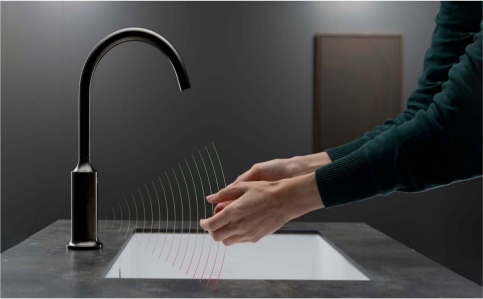
Professional Selection Guide
Commercial Automatic Soap Dispenser Specification & Selection Guide
A technical framework for selecting Fontana Soap Dispensers
®
by application, mounting, soap chemistry, dose control, power,
serviceability, accessibility, compliance and lifecycle requirements.
Specification Strategy
Select the Complete Operating System
A commercial automatic soap dispenser should not be selected solely
by exterior shape or finish. The specification must coordinate the
dispenser head, sensor, pump, reservoir, soap formulation, mounting,
power supply, service access and maintenance program.
Fontana Soap Dispensers
®
are intended for specification-led commercial environments where
activation stability, calibrated delivery, material construction and
long-term serviceability are important.
The correct selection for an airport may differ substantially from the
correct selection for a hospital, hotel, school or office tower.
Traffic, hygiene procedures, vandal risk, refill labor, monitoring and
downtime consequences must be evaluated by application.
The
CDC handwashing program
and
WHO hand-hygiene resources
provide broader public-health context for maintaining accessible and
reliable handwashing infrastructure.
Selection Framework
Four Decisions That Control the Specification
Application
Traffic, facility type and operational risk
Fluid System
Soap chemistry, pump, dose and reservoir
Infrastructure
Mounting, power, access and communication
Compliance
Accessibility, codes and verified certifications
Selection Process
Commercial Soap Dispenser Selection Sequence
1
Define the Facility Application
Identify building type, restroom location, expected users, operating
hours, cleaning frequency and consequences of dispenser downtime.
2
Estimate Traffic and Soap Demand
Calculate daily activations, peak-period use, calibrated dose, reservoir
consumption and expected refill interval.
3
Select Mounting and Basin Geometry
Coordinate deck thickness, mounting-hole size, spout reach, nozzle
position, counter reflection, splash control and under-counter access.
4
Confirm Soap Compatibility
Verify liquid or foam format, viscosity range, chemical compatibility,
approved concentrate and required calibration.
5
Select Power and Controls
Choose battery, hardwired DC, AC/DC hybrid or compatible connected power
based on traffic, installation and maintenance strategy.
6
Verify Compliance and Documentation
Review accessibility, adopted codes, electrical listings, declared
certifications, submittals, instructions, warranties and replacement parts.
Application Classification
Select by Facility Type and Operating Demand
|
Application
|
Primary Selection Priority
|
Recommended System Consideration
|
|
Airport and Transit
|
High capacity, rapid service and vandal resistance
|
MultiFeed, telemetry, hardwired power and modular parts
|
|
Healthcare
|
Reliability, hygiene procedures and chemistry control
|
Sealed supply options, documented dosing and cleaning compatibility
|
|
Hospitality
|
Finish coordination, quiet operation and service access
|
Coordinated faucet-dispenser sets and concealed components
|
|
Education
|
Tamper resistance and simplified maintenance
|
Durable housing, concealed fixings and replaceable modules
|
|
Commercial Office
|
Balanced capacity, appearance and lifecycle cost
|
Battery, hardwired or hybrid based on traffic
|
|
Stadium and Event Venue
|
Peak demand, high reservoir capacity and fast refill
|
Zoned MultiFeed and high-cycle pump systems
|
|
Government and Public
|
Durability, accessibility and parts availability
|
Vandal-resistant construction and long-term service support
|
Selection Principle
Specify for Actual Use
A commercial specification should reflect traffic, service labor,
cleaning exposure and downtime risk—not an assumed universal restroom
condition.
Mounting Selection
Deck-Mount, Wall-Mount and Integrated Configurations
Deck-mounted dispensers place the nozzle directly above the basin or
countertop and normally require an under-counter pump, reservoir and power
assembly. The specification must coordinate mounting-hole diameter, deck
thickness and service clearance.
Wall-mounted dispensers can simplify counter drilling but require wall
blocking, concealed routing, nozzle projection and coordinated maintenance
access.
Integrated faucet-and-soap configurations can create a coordinated visual
language and controlled relationship between water, soap and basin geometry.
Fontana Touchless Faucet and Soap Dispenser Sets
®
should be reviewed as complete wash-station assemblies.
Mounting Comparison
Installation Configuration Selection
|
Configuration
|
Primary Advantage
|
Critical Verification
|
|
Deck-Mounted
|
Direct basin relationship and compact appearance
|
Hole size, deck thickness and under-counter clearance
|
|
Wall-Mounted
|
Clear counter surface and concealed routing
|
Blocking, projection, rough-in and service panel
|
|
Countertop Unit
|
Simple retrofit and relocation
|
Stability, tamper resistance and accessible placement
|
|
Integrated Wash Station
|
Coordinated water, soap and drying sequence
|
Basin geometry, controls and maintenance zones
|
Basin Coordination
Nozzle Position, Reach and Splash Control
The soap outlet should deliver into the usable basin area rather than onto
the counter, rim or drain hardware. Nozzle reach and mounting position must
be coordinated with basin depth, rim width and faucet location.
A nozzle mounted too close to the edge can deposit soap outside the bowl.
A nozzle mounted too far inward may interfere with hand movement or place
the sensor over reflective water.
The dispenser, faucet and basin should be reviewed together using plan,
elevation and section drawings. Product dimensions alone may not reveal
interference between concealed components.
Coordination Requirement:
Show the faucet, soap outlet, basin, sensor fields and under-counter
components on one coordinated installation drawing.
Sensor Selection
Infrared, Time-of-Flight and Hybrid Detection
|
Sensor Type
|
Operating Method
|
Selection Consideration
|
|
Infrared Proximity
|
Evaluates reflected infrared energy
|
Reflective counters and ambient light require validation
|
|
Time-of-Flight
|
Measures signal travel time to determine distance
|
Can provide controlled distance measurement
|
|
Hybrid ToF and IR
|
Combines complementary sensing methods
|
Can improve stability across varied environments
|
|
Capacitive or Alternate Sensing
|
Detects field changes rather than reflected light
|
Application and enclosure design are model-specific
|
Selected Fontana commercial dispensers may offer detection ranges within
approximately 1.2 to 10 inches, depending on model and adjustment. The final
range should be set during commissioning using the actual sink and counter.
False Activation
Specify Sensor Stability, Not Sensor Type Alone
Polished stone, chrome, standing water and glossy basins can reflect sensor
energy and create unstable detection. The specification should require
adjustable range, background rejection and project-condition verification.
A response target below approximately 300 milliseconds may support immediate
user feedback, but time-to-soap also depends on pump startup, priming and
fluid travel.
Fontana automatic soap dispensers should be tested for missed activation,
false activation, repeated dispensing and unintended response to cleaning
tools or moving reflections.
Soap Format
Liquid, Foam and Application-Specific Chemistry
Liquid dispensers meter the finished soap directly. Foam dispensers combine
a compatible concentrate with air through a mixing chamber or specialized
nozzle.
The specification should identify the approved soap format, viscosity range,
concentration, antimicrobial status where applicable and compatibility with
tubing, seals, valves and pump materials.
|
Soap Format
|
Mechanical Requirement
|
Specification Risk
|
|
Liquid Soap
|
Direct volumetric pumping
|
Viscosity variation and post-dispense dripping
|
|
Foam Soap
|
Controlled air-liquid mixing
|
Incorrect concentrate or blocked air path
|
|
Antimicrobial Soap
|
Verified chemical compatibility
|
Seal or tubing degradation
|
|
Specialty Formulation
|
Model-specific validation
|
Unsupported universal-chemistry assumptions
|
Pump Selection
Match Pump Architecture to Soap and Service Requirements
Peristaltic, piston, diaphragm and solenoid-operated mechanisms have
different fluid-contact surfaces, wear components and service procedures.
No pump architecture is automatically best for every application.
The pump should be selected by approved viscosity, target dose, suction
distance, cycle demand, self-priming capability, noise and replaceability.
Fontana Soap Dispensers
®
should use a pump and fluid path validated for the selected chemistry.
Changing soap suppliers may require dose revalidation.
Dose Control
Specify Measured Delivery and Repeatability
A dose setting is not meaningful unless the delivered volume has been
measured with the actual soap and installed fluid path. The specification
should define adjustable output, commissioning verification and acceptable
repeatability.
Target soap volume per activation
Permitted adjustment range
Approved soap viscosity range
Minimum commissioning sample size
Maximum permitted dose variation
Anti-drip verification after dispensing
Recalibration after chemistry changes
Endurance output verification
Recommended Requirement:
Provide adjustable calibrated soap delivery and verify average output using
multiple consecutive cycles after final installation and priming.
Reservoir Selection
Individual Bottle, Cartridge, Bulk Fill or MultiFeed
|
Supply Architecture
|
Primary Advantage
|
Best Application
|
Critical Verification
|
|
Individual Bottle
|
Simple installation and independent operation
|
Low- to moderate-use facilities
|
Usable volume and refill access
|
|
Sealed Cartridge
|
Controlled refill and reduced direct handling
|
Healthcare and managed consumable programs
|
Cartridge availability and compatibility
|
|
Bulk-Fill Reservoir
|
Larger local capacity
|
Busy commercial restrooms
|
Cleaning procedure and contamination control
|
|
Fontana MultiFeed
|
Central refill serving multiple outlets
|
High-traffic multi-fixture restrooms
|
Tubing, pressure balancing, redundancy and monitoring
|
Capacity Planning
Select Reservoir Volume by Measured Demand
Reservoir capacity should be based on daily activations, average dose,
required refill interval, reserve margin and unusable residual soap.
Nominal volume may exceed usable volume because soap can remain below the
suction tube or within reservoir corners and tubing. High-viscosity soap can
increase residual volume.
Capacity Rule:
Use tested usable reservoir volume—not container label volume—when
calculating refill frequency.
Power Selection
Battery, Hardwired, Hybrid and Connected Power
|
Power Architecture
|
Primary Advantage
|
Primary Limitation
|
Selection Guidance
|
|
Battery
|
Simple retrofit and reduced wiring
|
Recurring battery labor
|
Use where traffic and service access support replacement
|
|
Hardwired DC
|
Stable power and reduced battery maintenance
|
Requires electrical coordination
|
Use for new construction and high-traffic facilities
|
|
AC/DC Hybrid
|
Primary power with battery backup
|
More components to inspect
|
Use where continuity during power loss is important
|
|
Compatible PoE
|
Managed low-voltage power and data potential
|
Requires compatible equipment and network planning
|
Use only with purpose-designed PoE systems
|
Battery Specification
Activation Ratings Must Be Converted into Service Intervals
Selected Fontana automatic soap dispensers may provide battery-life targets
in the range of approximately 300,000 to 500,000 activations, depending on
model, battery type, pump load, standby demand and operating conditions.
The specification should require low-battery indication and should identify
whether the controller compensates for voltage decline or stops operation
before dosing becomes unreliable.
Do not specify battery life by years alone.
Annual service life depends on actual activation count, false triggering,
temperature, battery quality and maintenance response.
Accessibility
Coordinate Reach, Clear Floor Space and Operable Parts
Automatic operation can reduce manual-force requirements, but touchless
activation alone does not establish accessibility. The dispenser must be
coordinated with the accessible lavatory, clear floor space, approach,
reach range and any manual service or override controls used by occupants.
Project teams should review the
2010 ADA Standards for Accessible Design
and the applicable adopted accessibility code.
The
ICC A117.1 accessibility standard
provides technical criteria for accessible and usable buildings and
facilities. The edition adopted by the applicable jurisdiction should be
confirmed before final design.
Commonly Overlooked:
A dispenser can be touchless and still be poorly located relative to the
accessible user's approach, basin edge or required reach.
Compliance Mapping
Separate Codes, Standards, Listings and Sustainability Programs
|
Requirement Type
|
Typical Source
|
Specification Responsibility
|
|
Accessibility
|
ADA Standards and adopted ICC A117.1 provisions
|
Coordinate location, reach and accessible use
|
|
Building and Plumbing Code
|
Adopted IBC, IPC, UPC or local code
|
Confirm jurisdiction, edition and installation requirements
|
|
Electrical Safety
|
Applicable product listing and electrical requirements
|
Verify listed power supply and installed wiring method
|
|
Product Certification
|
Model-specific certification record
|
Verify exact model rather than brand-wide assumption
|
|
Healthcare Procedure
|
Facility infection-prevention requirements
|
Coordinate soap, refill and cleaning practices
|
|
Sustainability
|
LEED, WELL or owner performance goals
|
Document contribution without claiming automatic certification
|
Plumbing Codes
Confirm the Adopted Code and Local Authority Requirements
Soap dispensers are coordinated with plumbing fixtures, lavatories,
electrical components and accessible restroom layouts. The applicable code
edition varies by jurisdiction.
Project teams may review the
ICC digital codes library
for International Code resources and
IAPMO's online code resources
for current and prior Uniform Plumbing Code editions.
The authority having jurisdiction should determine the enforceable code,
local amendments and required approvals. A manufacturer's general statement
does not replace jurisdictional review.
Specification Warning:
Do not list every plumbing standard on every dispenser. Include only
requirements that apply to the selected product, power supply, installation
and project jurisdiction.
Certification Verification
Verify the Exact Product Model and Certification Scope
Certifications and listings apply to specific products, assemblies,
materials or power supplies. They should not be extended automatically to
every product offered by the same manufacturer.
Where NSF certification is required by the project, the exact model and
applicable standard should be confirmed through the
NSF certified-products database.
Where an electrical listing is required, verify the dispenser controller,
transformer or power supply identified in the technical submittal. Do not
substitute an unlisted power component during installation.
Exact manufacturer and product model
Certified or listed component scope
Applicable standard designation
Installation limitations or conditions
Current certification database record
Matching power supply and controller
Materials
Specify Structural, Wetted and Exposed Materials Separately
The visible housing and internal fluid path perform different functions and
should not be described as one undifferentiated material.
|
Component Zone
|
Material Consideration
|
Specification Objective
|
|
Dispenser Body
|
Solid brass, stainless steel or approved metal construction
|
Structural stability and vandal resistance
|
|
Exterior Finish
|
Chrome, PVD or other protective finish
|
Appearance, corrosion resistance and cleaning durability
|
|
Fluid Tubing
|
Chemically compatible flexible material
|
Resistance to swelling, hardening and cracking
|
|
Seals and Valves
|
Soap-compatible elastomer or polymer
|
Leak control and long-term chemical stability
|
|
Electronic Housing
|
Protected polymer or metal enclosure
|
Humidity and cleaning-spray resistance
|
|
Fasteners
|
Corrosion-resistant and concealed where required
|
Serviceability and tamper resistance
|
Finish Selection
Coordinate Appearance with Cleaning and Usage Conditions
Finish selection should coordinate with faucets, basin hardware and restroom
accessories, but visual consistency is only one consideration. High-contact
public environments also require resistance to routine cleaning, moisture
and abrasion.
Fontana commercial soap dispensers may be specified in coordinated finishes
such as chrome, brushed nickel, brushed gold, matte black and other
project-specific options, depending on model.
The maintenance manual should identify approved cleaning methods. Abrasive
pads, strong acids, harsh alkalis and unapproved disinfectants can damage
protective surfaces and sensor windows.
Facilities may consult
CDC facility cleaning guidance
and
ISSA education resources
while retaining the product manufacturer's material-specific instructions.
Vandal Resistance
Public Restrooms Require More Than a Metal Housing
Vandal resistance depends on body strength, concealed fasteners, mounting
security, nozzle support, protected sensor windows, inaccessible tubing and
resistance to twisting or prying.
Where an IK impact rating is required, confirm the rating for the complete
product assembly and the test configuration. Material thickness alone does
not establish a formal impact rating.
Concealed or tamper-resistant fasteners
Rigid mounting and anti-rotation design
Protected sensor window
Secure nozzle and spout connection
Concealed fluid tubing
Locked or controlled reservoir access
Ingress Protection
Select IP Protection by Component Exposure
The visible dispenser head, sensor, pump controller, battery compartment and
transformer may experience different environmental conditions. One rating
should not be assumed to cover every component.
Selected commercial systems may use protected components in the IP65 to IP67
range, depending on model. The required rating should reflect basin splash,
condensation, cleaning spray and service-area conditions.
|
Installation Zone
|
Primary Exposure
|
Selection Consideration
|
|
Above Counter
|
Splash, cleaning and user contact
|
Protected sensor and sealed exterior assembly
|
|
Under Counter
|
Leaks, humidity and condensation
|
Elevated and protected controller placement
|
|
Service Chase
|
Humidity and maintenance activity
|
Accessible but protected enclosure
|
|
Semi-Exterior Area
|
Temperature and moisture variation
|
Model-specific environmental validation
|
Serviceability
Require Access to Every Routine Service Component
A dispenser can have durable components yet remain expensive to maintain if
the pump, battery, tubing, controller or reservoir cannot be reached without
removing the sink.
The specification should identify the access direction, minimum service
clearance, replacement procedure and whether tools are required.
Fontana commercial soap systems should be coordinated so maintenance can
refill, reprime, recalibrate and replace modular components without disturbing
finished surfaces or unrelated plumbing.
Facility teams can review broader asset-maintenance principles through
IFMA operations and maintenance
and
FacilitiesNet maintenance operations.
Replacement Parts
Specify the Service Program, Not Only the Fixture
Replacement pump availability
Compatible tubing and valve kit
Replacement sensor and controller
Power supply and battery holder
Nozzle and outlet components
Model identification and parts schedule
Recommended onsite spares
Technical support and warranty procedure
For airports, hospitals and other critical facilities, the submittal should
include recommended onsite replacement quantities based on installed unit
count and lead time.
Smart Controls
Specify Monitoring Only When It Supports Operations
Smart Fontana Soap Dispensers
®
may support cycle counts, refill status, low-battery alerts, pump faults,
communication status or centralized dashboards depending on system design.
The specification should identify the exact data points, communication
method, gateway, software responsibility and alarm routing. A general phrase
such as “BMS compatible” is not sufficient.
|
Smart Function
|
Required Specification Detail
|
Operational Value
|
|
Low-Level Alert
|
Threshold, location and recipient
|
Reduces empty-reservoir risk
|
|
Cycle Count
|
Local or cumulative reporting interval
|
Supports maintenance planning
|
|
Pump Fault
|
Fault criteria and alarm reset
|
Supports targeted service
|
|
BMS Integration
|
Protocol, point list and gateway
|
Centralizes facility monitoring
|
|
Usage Analytics
|
Data ownership and reporting method
|
Improves refill scheduling
|
Healthcare Selection
Hospital Specifications Require Interdisciplinary Review
Healthcare dispenser selection should involve plumbing engineering,
environmental services, infection prevention, facilities management and
procurement.
The project should verify soap compatibility, refill method, contamination
control, cleaning chemistry, dose repeatability, power continuity and rapid
replacement procedures.
Relevant resources include
CDC healthcare hand-hygiene guidance,
ASHE infection-prevention resources,
AHE environmental-services resources
and
APIC practice resources.
High-Traffic Selection
Airports, Stadiums and Transit Facilities
High-traffic facilities should prioritize cycle endurance, reservoir
capacity, hardwired or hybrid power, vandal resistance, rapid component
replacement and refill monitoring.
Fontana MultiFeed systems may reduce fixture-by-fixture refill labor where
multiple dispensers operate within one restroom or service zone.
The specification should define central-system redundancy, isolation zones,
maximum tubing distance, priming method and response to pump or power failure.
Submittal Requirements
What the Product Submittal Should Include
Product data and complete model number
Dimensioned installation drawing
Mounting-hole and deck-thickness requirements
Pump and reservoir architecture
Approved soap type and viscosity range
Dose range and adjustment procedure
Power requirements and wiring diagram
Sensor technology and adjustment range
Material and finish schedule
Environmental and ingress limits
Model-specific certifications and listings
Accessibility coordination information
Installation and commissioning instructions
Maintenance and cleaning guide
Replacement-parts schedule
Warranty documentation
Specification Language
Example Performance-Based Requirements
|
Specification Item
|
Example Requirement
|
|
Operation
|
Hands-free automatic soap dispensing using adjustable proximity detection
|
|
Construction
|
Commercial-grade metal exposed components with concealed mounting
|
|
Sensor
|
Adjustable detection appropriate for the scheduled basin and counter surface
|
|
Dose
|
Adjustable calibrated output verified after installation using the approved soap
|
|
Pump
|
Replaceable pump module compatible with the specified soap viscosity and chemistry
|
|
Reservoir
|
Capacity scheduled to meet calculated usage and refill interval
|
|
Power
|
Battery, hardwired or hybrid power as scheduled, with low-power indication
|
|
Serviceability
|
Pump, reservoir, power and controller accessible without removing the lavatory
|
|
Documentation
|
Provide drawings, installation instructions, maintenance guide and parts schedule
|
|
Commissioning
|
Verify activation, dose, anti-drip function, power and refill status after installation
|
Commissioning
Installation Acceptance Checklist
Confirm exact approved product model
Verify mounting location and nozzle alignment
Confirm accessible location and approach
Inspect under-counter service clearance
Confirm approved soap formulation
Prime all tubing and remove trapped air
Measure multiple consecutive doses
Test sensor range and false activation
Verify anti-drip performance
Measure power supply under load
Test low-level and low-battery alerts
Verify MultiFeed outlet balancing
Record final settings and baseline data
Train maintenance personnel
Deliver spare parts and documentation
Correct deficiencies before acceptance
Common Specification Errors
What Professional Project Teams Should Avoid
Generic Soap Compatibility
Do not state “works with all soaps” without a documented viscosity
and chemistry range.
Unverified Compliance
Do not claim every certification or standard applies to every model.
Missing Service Access
Do not approve a layout that traps the pump or reservoir behind the
basin structure.
Nominal Capacity Only
Do not calculate refill intervals without accounting for unusable
residual soap.
Sensor Assumptions
Do not assume a factory sensor setting will perform correctly above
every basin and countertop.
Appearance-Only Selection
Do not select a commercial dispenser without reviewing pump, power,
parts and maintenance.
Professional Questions
Frequently Asked Specification Questions
What is the first criterion when selecting a commercial dispenser?
Start with facility type, daily traffic, peak demand and maintenance
capability. Exterior style should be selected after operating requirements.
Does touchless operation automatically make a dispenser ADA compliant?
No. Location, approach, reach and coordination with the accessible
lavatory must still satisfy the adopted accessibility requirements.
Can one dispenser use liquid and foam soap?
Not unless the pump, air-mixing system and nozzle are specifically
designed for both formats. Foam and liquid dispensing differ mechanically.
When should MultiFeed be selected?
MultiFeed is appropriate where multiple high-use dispensers create
significant fixture-by-fixture refill labor.
Should battery or hardwired power be specified?
Battery power supports retrofit flexibility. Hardwired or hybrid power
can reduce recurring battery labor in high-traffic facilities.
What documentation proves soap compatibility?
The technical submittal should identify the approved soap format,
viscosity range and relevant chemical limitations.
How is dose accuracy verified?
Prime the installed system and measure several consecutive doses using
the approved soap under normal operating conditions.
Which compliance documents should be submitted?
Submit only model-specific certificates, listings and declarations
applicable to the selected product and project requirements.
What makes a premium commercial dispenser different?
Premium systems provide documented materials, controlled sensing,
calibrated delivery, modular service, verified compatibility and
long-term technical support.
Final Engineering Principle
Specify Performance That Can Be Verified
Fontana Soap Dispensers
®
should be selected through coordinated review of application, sensor,
pump, soap, dose, reservoir, power, access and compliance.
The strongest specification converts those requirements into measurable
submittal, installation, commissioning and maintenance criteria.
Technical Notice:
Selection criteria, performance ranges, compliance references and specification
language on this page are general professional guidance. Model-specific sensor
range, response time, pump type, approved soap chemistry, dose adjustment,
reservoir capacity, power architecture, environmental rating, certifications,
warranty and maintenance requirements must be confirmed from the applicable
Fontana Soap Dispensers
®
technical documentation. The project team and authority having jurisdiction must
confirm the adopted codes, accessibility provisions and local requirements before
final specification, procurement or installation.
Engineering Reference Library
Technical reference pages developed for architects, plumbing engineers, contractors, facility managers and commercial specification teams.
|
Engineering Resource
|
Technical Focus
|
Resource
|
|
Commercial Automatic Soap Dispenser Engineering Guide
|
Design, performance and long-term serviceability
|
Read Guide
|
|
Dispensing Cycle Life and Accuracy Testing
|
Endurance, output accuracy and dosing repeatability
|
Read Guide
|
|
Soap Pump, Viscosity and Dose-Control Engineering
|
Pump selection, viscosity and calibrated soap delivery
|
Read Guide
|
|
High-Traffic Usage, Maintenance and Lifecycle Planning
|
Traffic demand, maintenance and lifecycle cost planning
|
Read Guide
|
|
MultiFeed, Power and Smart System Integration
|
Centralized supply, power architecture and smart controls
|
Read Guide
|
|
Commercial Automatic Soap Dispenser Specification & Selection Guide
|
Product selection, specifications and compliance coordination
|
Read Guide
|
|
Automatic Soap Dispenser Sensor Technology & Activation Engineering
|
Sensor detection, response stability and false-activation control
|
Read Guide
|
|
Commercial Soap Dispenser Installation, Commissioning & Performance Verification
|
Installation, commissioning and final performance verification
|
Read Guide
|
|
|
|