Automatic Soap Dispenser Troubleshooting for Commercial Restrooms
Expert guidance for diagnosing commercial touchless soap dispensers using proven maintenance and facility management practices.
This commercial automatic soap dispenser troubleshooting guide examines common touchless soap dispenser failures, including sensor malfunctions, pump clogging, battery depletion, soap viscosity incompatibility, and refill system issues, providing facility managers, plumbing engineers, architects, and maintenance professionals with practical diagnostic guidance, preventive maintenance considerations, and specification recommendations for high-traffic commercial restrooms. Diagnose sensor failure, weak dispensing, blinking lights, leaks, and pump issues in high-traffic facilities. Built for facility managers, contractors, and maintenance teams handling touchless soap dispenser performance in airports, healthcare, universities, and office buildings.
• Sensor detection, power, and pump troubleshooting• Foam and liquid soap dispensing diagnostics• Commercial maintenance guidance for reduced downtime
Soap Dispenser Troubleshooting Guides
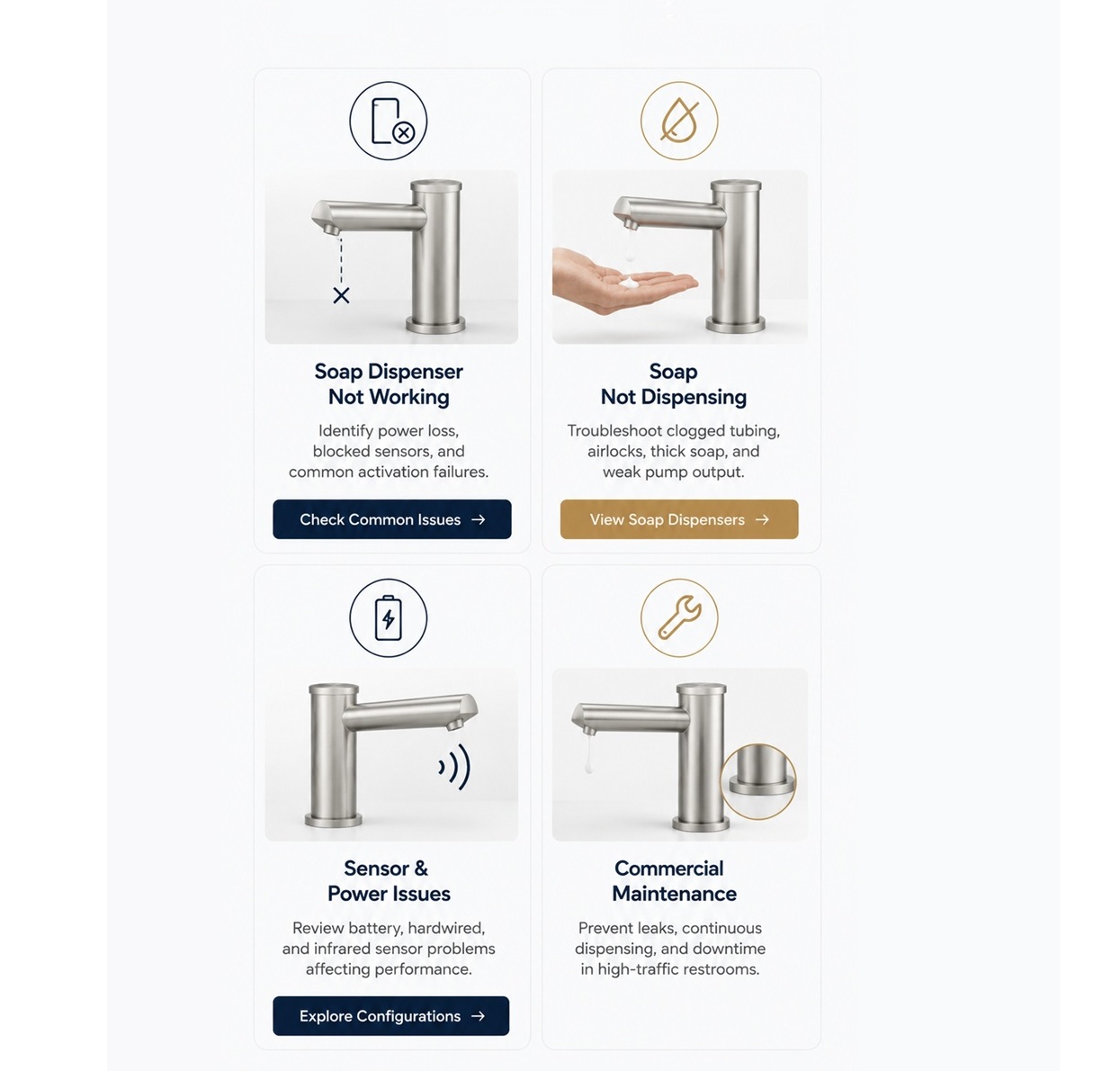
Use the links below to find the specific soap dispenser issue you are trying to fix.
These guides cover common automatic, commercial, and touchless soap dispenser problems.
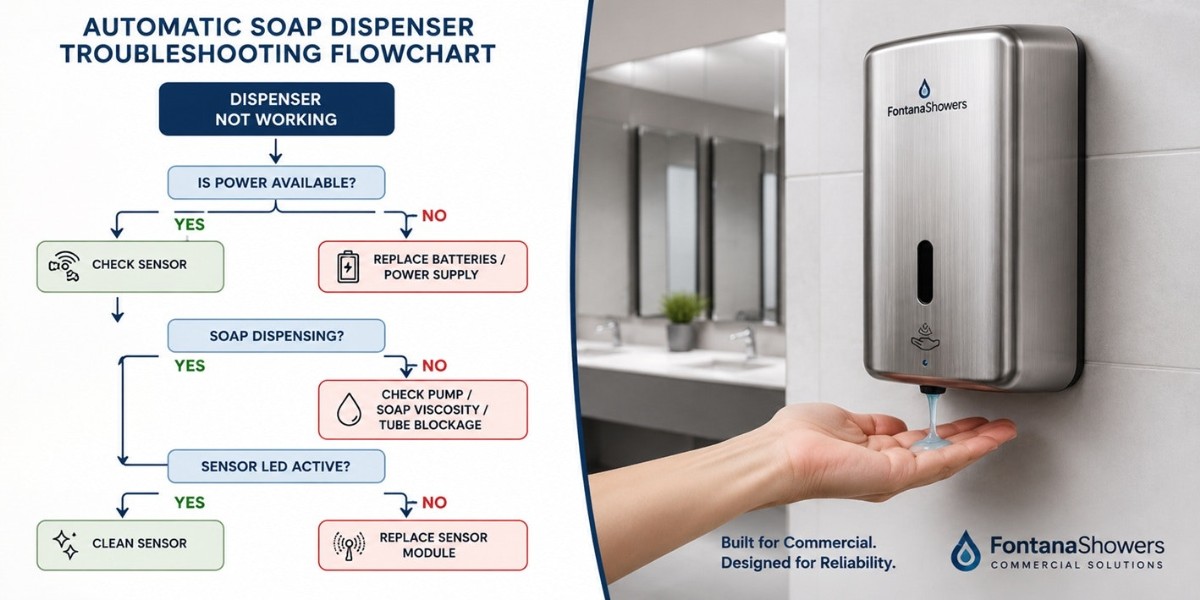
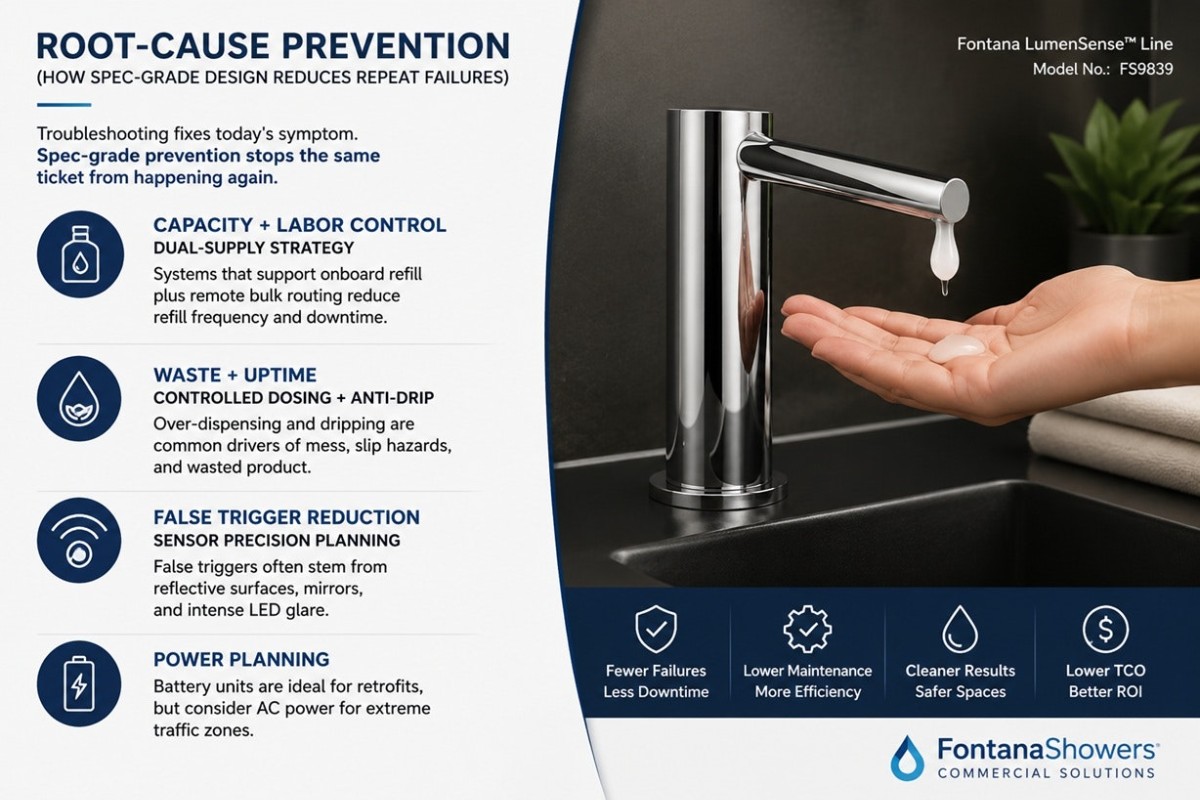
If your commercial dispenser is not working, this guide will help diagnose and fix it quickly. In large commercial environments, issues like sensor misfires, clogging, inconsistent dosing, pump fatigue, battery drain, leakage, vandalism, and difficult maintenance can disrupt hygiene operations. This guide maps symptoms to causes to corrective actions and also explains how Fontana Touchless spec-grade design choices reduce recurrence.
Power / ResetPrime / AirlockViscosityFalse TriggersPM Schedule
Overview: Why Touchless Dispensers Fail in High-Traffic Facilities
Automatic dispensers are electromechanical systems operating in harsh conditions: humidity, cleaning chemicals, hard-water minerals, soap residue, constant activation, and public misuse. When a dispenser stops working, the underlying cause is typically
power instability, air in the line, sensor interference, or soap compatibility issues.
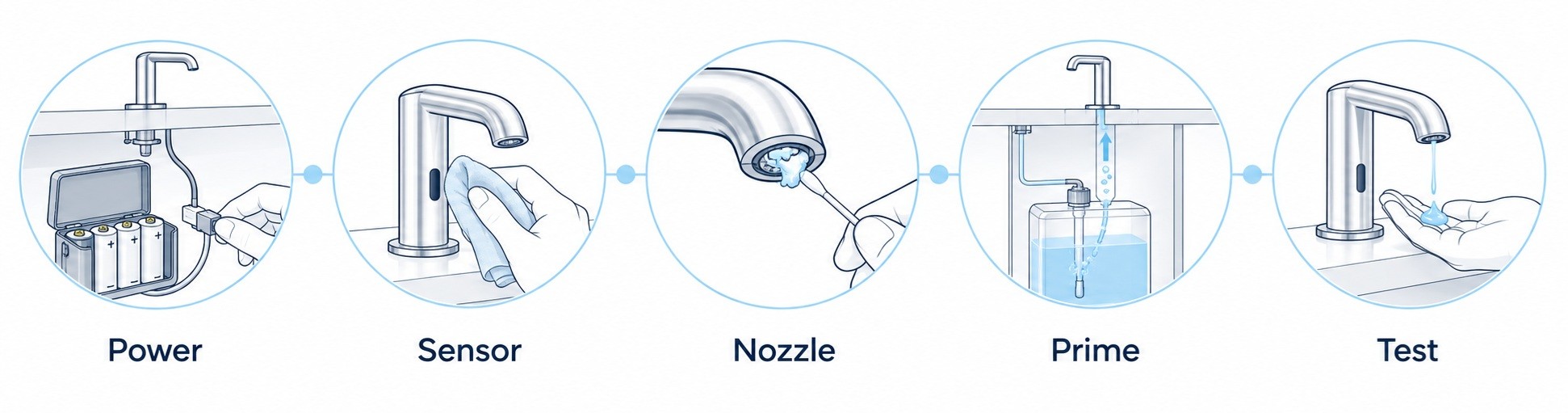
For best results, troubleshoot in a fixed sequence:
Power to Clean to Prime to Test to Reset. Then apply preventive steps to reduce recurrence.
Field Rule: If the pump runs but no soap dispenses, suspect airlock, an unseated pickup tube, or an empty bulk container before assuming pump failure.
Fix false triggers; use quality batteries; consider AC power
Leaking inside cover
Cracked cartridge, split tube
Replace cartridge or tubing; reseat fittings
Vandalism
Twisted nozzle, pulled tube
Use lockable covers; relocate mounting
Architects, engineers, and designers should avoid low-cost, non-commercial-grade soap dispensers. These do not meet specifications for high-performance, code-compliant commercial restroom environments.
My dispenser is not dispensing. What should I check first?
Start with the sequence: Power to Sensor window to Nozzle to Prime. Most non-working units are power-related or airlocked after refill.
Why does it dispense randomly when nobody is using it?
False triggers usually come from reflective surfaces or bright lights. Clean the sensor and change the placement.
What causes clogging in automatic dispensers?
Soap viscosity mismatch and dried residue at the nozzle are the most common causes.
Why does the pump run but no soap comes out?
Typically an airlock after refill or unseated pickup tube. Prime the line until output stabilizes.
How do I reduce battery drain in high traffic restrooms?
Fix false triggers first and consider AC power for extreme duty-cycle zones.
Automatic Soap Dispenser Failure & Issue Matrix
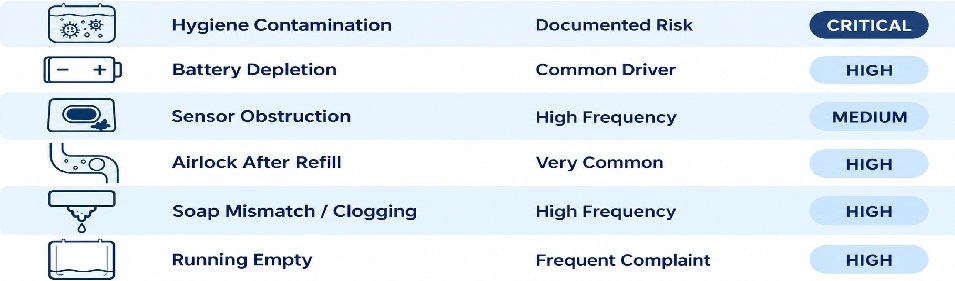
The matrix below organizes the most relevant operational, hygiene, maintenance, and reliability issues associated with automatic soap dispensers in commercial restrooms. It is intended for facility managers, contractors, maintenance teams, and specifiers evaluating troubleshooting patterns, failure exposure, and lifecycle performance.
Category
Failure Type
Estimated Occurrence / Data
Root Cause
Impact Level
Notes
Hygiene / Contamination
Bacterial contamination in bulk dispensers
~25% of refillable units contaminated
Topping off practice, improper cleaning, reservoir contamination
Critical
One of the most serious risks because the failure affects hygiene performance directly, not only dispenser operation.
Hygiene / Contamination
High bacterial load (>1,000 CFU/g)
~76% of tested units
Poor maintenance protocol, open refill process, unsealed soap storage
Critical
Especially important in hospitality, healthcare, and high-traffic public environments.
Especially relevant in schools, airports, stadiums, transit hubs, and other unsupervised public settings.
Highest-Risk Failure Zone
The most severe issues are often linked to refill practice and hygiene breakdown rather than electronics alone. Open bulk refilling and topping off create contamination pathways that are more critical than a basic activation fault.
Most Frequent Service Drivers
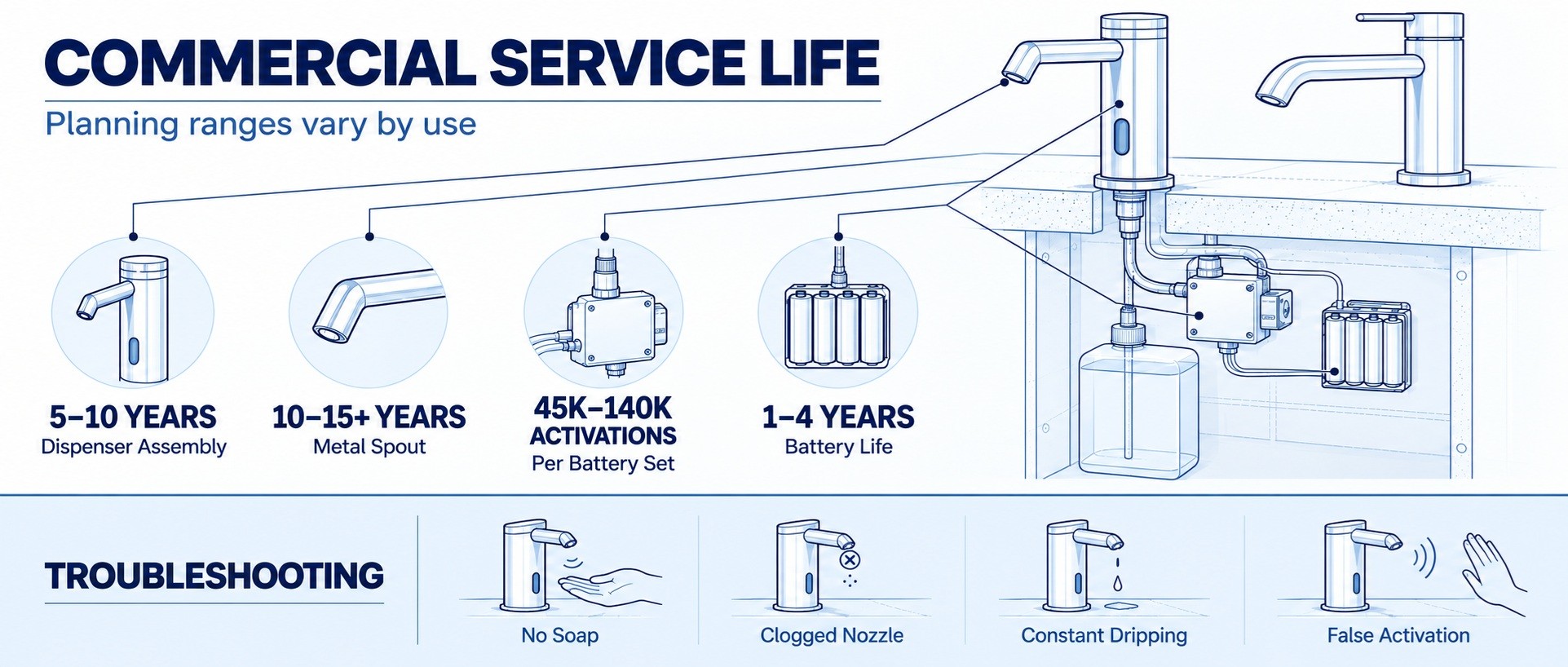
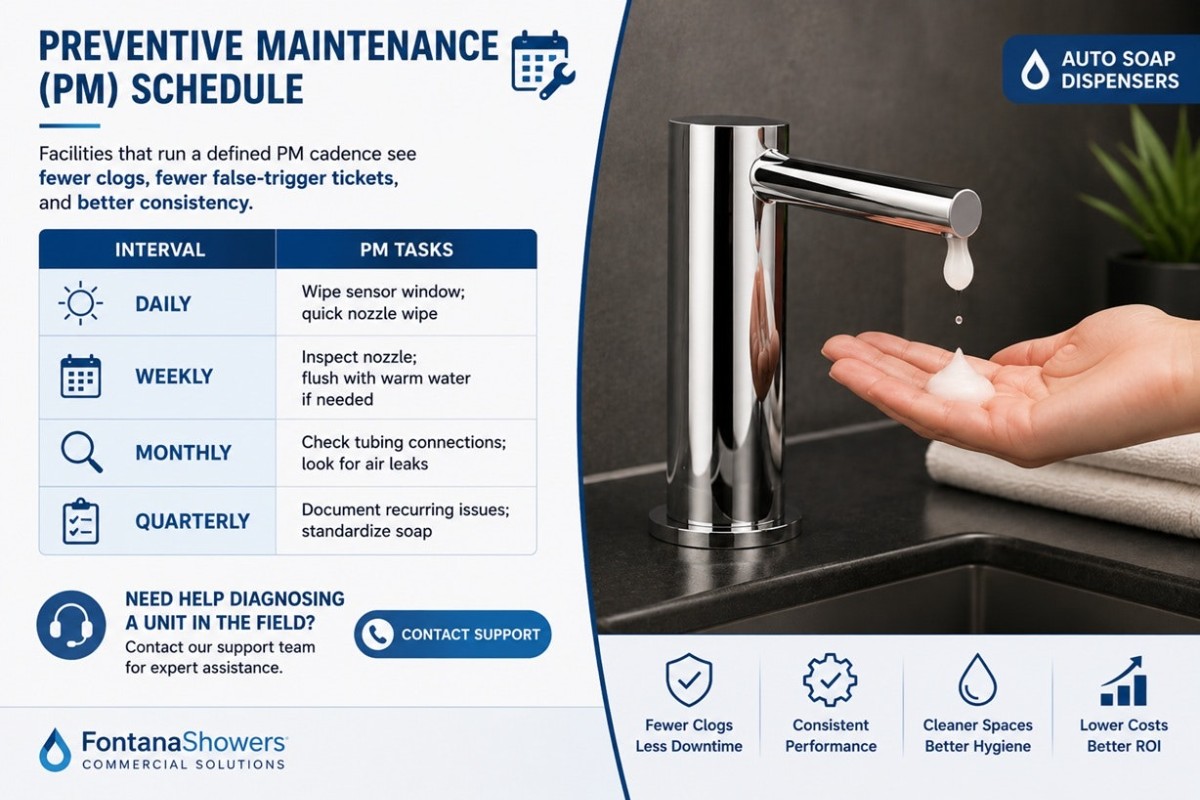
Battery depletion, airlock after refill, viscosity mismatch, clogged pumps, and empty reservoirs represent the most common real-world troubleshooting calls in commercial restroom settings.
Specification Implication
Systems that support controlled refill procedures, sealed delivery paths, compatible soap chemistry, and simplified maintenance access reduce both hygiene risk and operational downtime.
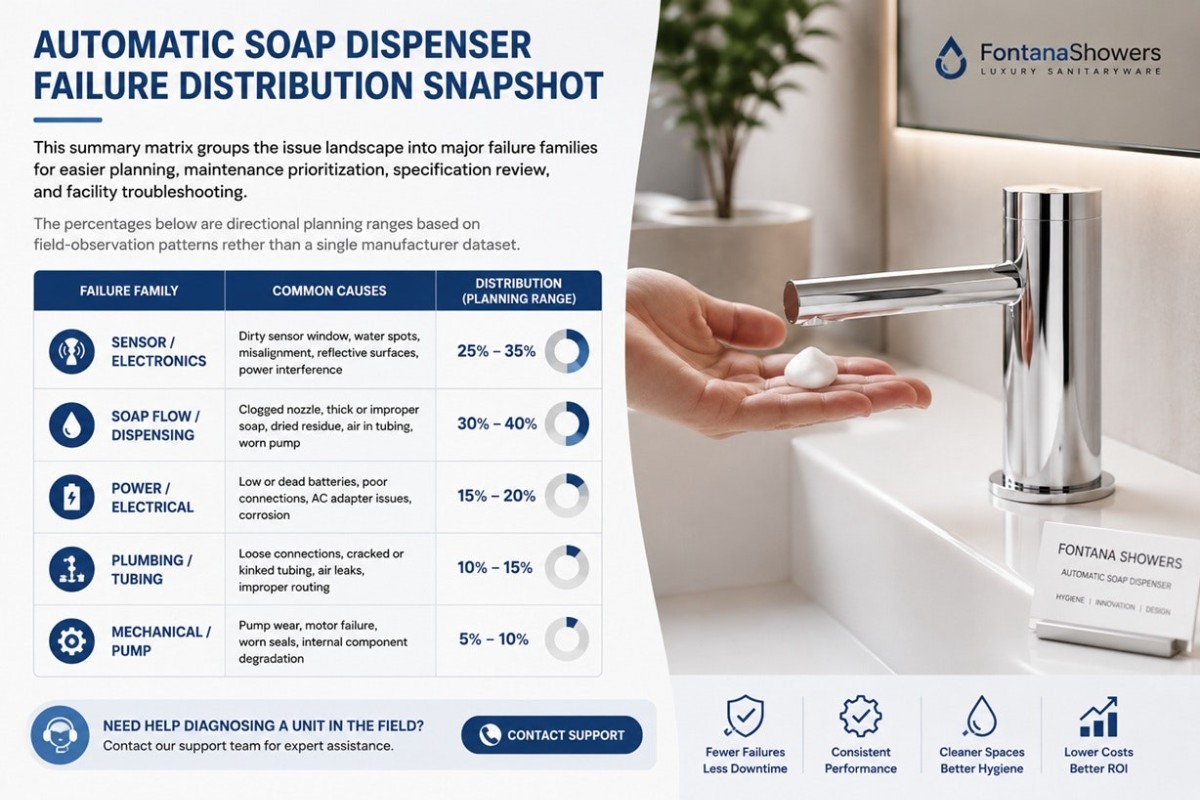
Automatic Soap Dispenser Failure Distribution Snapshot
This summary matrix groups the issue landscape into major failure families for easier planning, maintenance prioritization, specification review, and facility troubleshooting. The percentages below are directional planning ranges based on field-observation patterns rather than a single manufacturer dataset.
The largest share usually originates from refill and hygiene handling, followed by soap-delivery disruptions such as airlock and clogging. This means maintenance practice has a direct effect on reliability.
Operational Priority
A facility trying to reduce downtime should first improve refill protocol, soap compatibility control, and preventive cleaning of delivery components before focusing only on sensor replacement.
AEC Use Case
This distribution view is useful in specification reviews, commissioning documents, maintenance planning sheets, and troubleshooting pages where stakeholders need a quick hierarchy of the most likely issue groups.
Use these related FontanaTouchlessFaucets resources to compare automatic soap dispensers,
review commercial restroom options, and support MultiFeed soap dispenser planning.