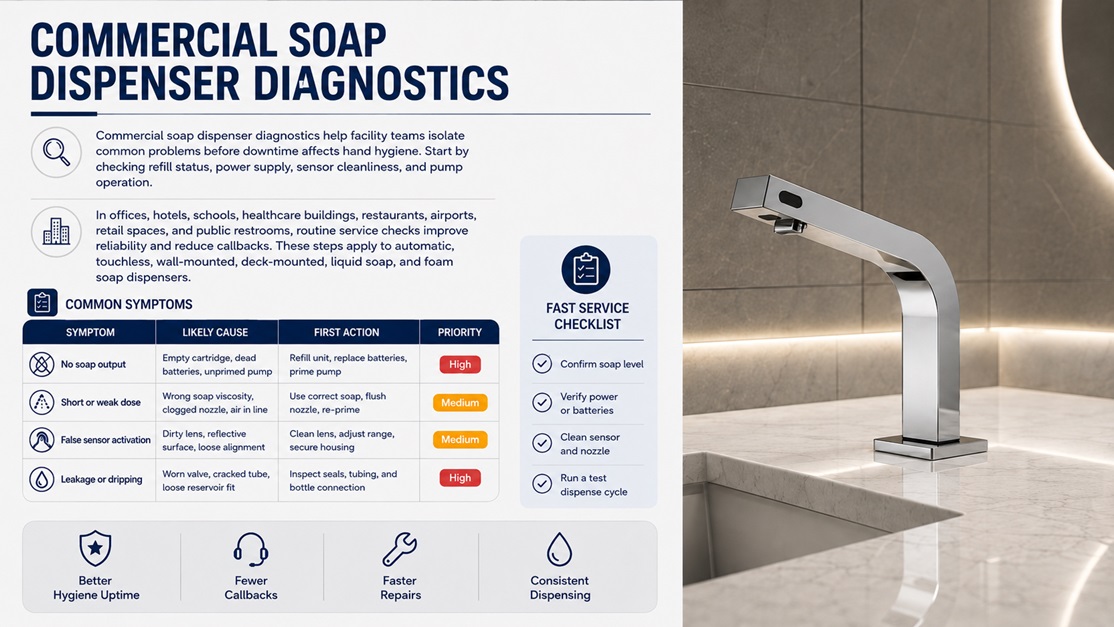
Commercial soap dispenser troubleshooting helps facility managers, maintenance teams, and restroom service staff quickly diagnose common problems such as no soap output, weak sensor response, blinking lights, leaking, clogged nozzles, empty refills, and battery failure.
In high-traffic restrooms, a soap dispenser problem can affect hygiene, user experience, and maintenance efficiency. This guide covers practical troubleshooting steps for automatic, touchless, wall-mounted, deck-mounted, liquid soap, and foam soap dispensers used in offices, hotels, schools, healthcare facilities, restaurants, airports, retail buildings, and public restrooms.
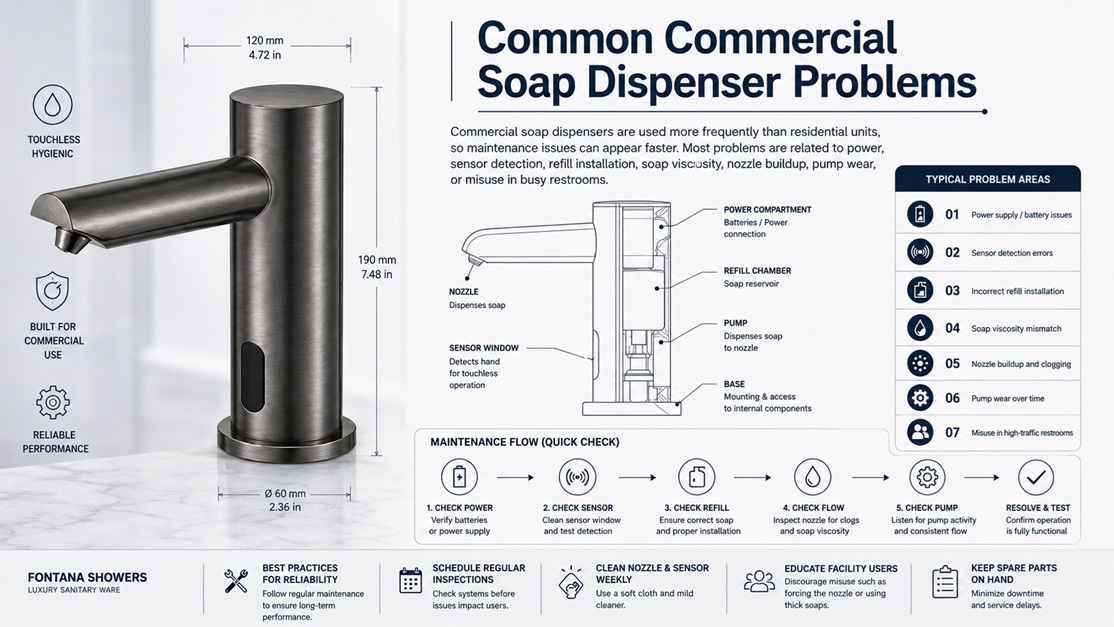
Commercial soap dispensers are used more frequently than residential units, so maintenance issues can appear faster. Most problems are related to power, sensor detection, refill installation, soap viscosity, nozzle buildup, pump wear, or misuse in busy restrooms.
No Soap DispensingThe refill may be empty, the cartridge may be loose, the pump may need priming, or the nozzle may be blocked.
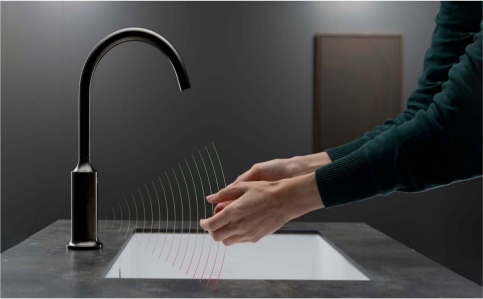
Sensor Not RespondingA dirty sensor window, weak batteries, incorrect hand placement, or blocked detection area can stop touchless activation.
Blinking Red LightA red warning light may indicate low batteries, refill problems, sensor obstruction, pump blockage, or a reset error.
Leaking or DrippingLeaks may come from the nozzle, refill connection, pump seal, reservoir, cartridge cap, or overfilled tank.
Weak or Inconsistent OutputLow battery power, thick soap, pump wear, air in the line, or partial nozzle blockage may reduce soap delivery.
Frequent Maintenance CallsIf the dispenser fails repeatedly in a high-traffic restroom, it may not be suitable for commercial use.
Facility Tip: For commercial restrooms, do not troubleshoot only after failure. Add battery checks, refill inspection, nozzle cleaning, and sensor cleaning to routine maintenance.
Use this step-by-step process when a commercial soap dispenser is not working properly. Begin with the simplest maintenance checks before replacing parts or the full dispenser.
Check the soap refill level.
Open the dispenser and confirm that the refill bottle, cartridge, bag, or reservoir contains enough soap. Replace empty refills before troubleshooting the sensor or pump.
Confirm the refill is installed correctly.
Remove and reinstall the refill firmly. Make sure the cartridge locks into place and the outlet connects properly to the pump inlet.
Replace or test the batteries.
Install fresh batteries of the recommended type. Weak batteries can cause sensor failure, blinking red lights, weak motor sound, or no soap output.
Clean the sensor window.
Wipe the sensor area with a soft damp cloth. Soap residue, fingerprints, water spots, dust, or cleaning chemical film can interfere with touchless detection.
Inspect the nozzle.
Check the outlet for dried soap, buildup, or blockage. A clogged nozzle can stop dispensing or cause slow dripping after each activation.
Prime the pump.
After refill replacement, activate the dispenser several times. Air in the pump line may prevent soap from dispensing immediately.
Check soap compatibility.
Confirm whether the unit requires liquid soap, foam soap, sanitizer, or a specific cartridge system. Using the wrong soap type can cause clogs, leaks, or weak output.
Inspect for leaks inside the housing.
Look for soap collecting around the refill, pump, battery compartment, sensor area, or bottom of the dispenser. Fix leaks quickly to protect electronics.
Reset the dispenser.
If the dispenser has a temporary electronic issue, turn it off, remove batteries for 30 to 60 seconds, reinstall fresh batteries, close the cover, and test again.
Troubleshooting by Symptom
In commercial restrooms, quick diagnosis matters. Use the symptom list below to identify the most likely cause and the first action to take.
Dispenser Does Not Activate
Replace batteries.
Check battery direction and contacts.
Clean the sensor window.
Make sure the cover is fully closed.
Reset the dispenser.
Dispenser Activates But No Soap Comes Out
Check the refill level.
Reinstall the cartridge or bottle.
Clean the nozzle.
Prime the pump several times.
Confirm correct soap type and viscosity.
Dispenser Leaks or Drips
Clean dried soap from the nozzle.
Check the refill cap, seal, and connection.
Avoid overfilling the reservoir.
Inspect for cracked cartridges or tanks.
Use compatible soap to prevent poor shutoff.
Dispenser Blinks Red
Replace batteries first.
Check for empty or loose refills.
Clean the sensor area.
Inspect the nozzle for blockage.
Reset the unit and test again.
Commercial Maintenance Checklist
A maintenance checklist can reduce dispenser downtime and improve restroom reliability. Commercial soap dispensers should be inspected regularly, especially in high-traffic facilities.
Check soap levels during each restroom service visit.
Replace refills before they are fully empty.
Wipe the sensor window to prevent detection problems.
Clean the nozzle to prevent clogs and dripping.
Inspect the inside housing for soap leaks or residue.
Replace batteries on a schedule, not only after failure.
Confirm the dispenser cover closes securely.
Use only compatible liquid soap, foam soap, or refill cartridges.
Keep spare batteries and refills available for maintenance staff.
Document repeat failures to identify units that should be replaced.
Commercial Best Practice: A dispenser that fails repeatedly in the same location may be exposed to heavy use, moisture, vandalism, incompatible soap, or installation conditions that require a more durable commercial-grade solution.
Liquid Soap, Foam Soap, and Refill Compatibility
Refill compatibility is one of the most important parts of commercial soap dispenser troubleshooting. Using the wrong soap can cause poor dispensing, leaks, clogs, weak output, or pump damage.
Liquid Soap Dispensers
Use liquid soap with a suitable viscosity for the pump.
Avoid soap that is too thick unless the dispenser is designed for it.
Clean the nozzle regularly because liquid soap can dry around the outlet.
Prime the pump after replacing a refill or empty reservoir.
Foam Soap Dispensers
Use compatible foam soap or foam cartridges.
Do not use standard thick liquid soap in a foam-only dispenser.
Check the cartridge connection to ensure proper air-and-soap mixing.
Replace damaged or collapsed refill cartridges.
For facility managers, standardizing refill types across restrooms can reduce mistakes and simplify maintenance. Mixing incompatible refills across different dispenser models often causes unnecessary troubleshooting issues.
When to Repair vs Replace a Commercial Soap Dispenser
Some commercial soap dispenser problems are easy to fix. Others become recurring maintenance issues that cost more time than replacement. Knowing when to replace a dispenser helps maintain restroom hygiene and reduce service interruptions.
Repair or Service the Dispenser When:
The batteries are weak or installed incorrectly.
The refill is empty, loose, or incorrectly seated.
The sensor window is dirty or blocked.
The nozzle has dried soap buildup.
The pump needs priming after refill replacement.
The issue is new and not recurring.
Replace the Dispenser When:
The dispenser fails repeatedly after maintenance.
Soap leaks into the battery or sensor area.
The internal pump no longer draws soap reliably.
The sensor activates randomly or does not respond with fresh batteries.
The housing, reservoir, or mounting area is cracked or damaged.
The dispenser is not durable enough for the traffic level.
In busy commercial restrooms, replacement may be the better option when downtime, repeated service calls, and user complaints become frequent.
Recommended Commercial Soap Dispenser Solutions
If your commercial soap dispenser requires constant troubleshooting, consider upgrading to a more reliable automatic soap dispenser system. A properly selected dispenser can improve hygiene, reduce touchpoints, streamline maintenance, and coordinate with surrounding commercial restroom fixtures.
For commercial projects, look for durable construction, responsive sensor technology, easy refill access, compatible soap options, secure mounting, efficient battery operation, and finishes that match touchless faucets or restroom design standards.
Commercial soap dispenser issues often connect to batteries, sensors, refill installation, leaks, and soap flow. Use these related guides to troubleshoot specific problems.
Common causes include weak batteries, empty refills, dirty sensors, blocked nozzles, incorrect soap type, loose cartridges, pump air, leaks inside the housing, or internal component wear.
How do I troubleshoot a touchless commercial soap dispenser?
Start by replacing batteries, checking the refill, cleaning the sensor, clearing the nozzle, confirming the correct soap type, priming the pump, and resetting the dispenser.
Why does a commercial soap dispenser stop dispensing?
It may stop dispensing because the refill is empty, the cartridge is loose, the nozzle is clogged, the pump line has air, the soap is too thick, or the batteries are too weak to run the pump.
How often should commercial soap dispensers be serviced?
Service frequency depends on traffic level, but high-use restrooms should have soap levels, batteries, sensors, nozzles, and refill connections checked during routine maintenance visits.
Can the wrong soap damage a commercial dispenser?
Yes. Soap that is too thick, too thin, or incompatible with the dispenser type can cause clogs, weak output, leaking, pump strain, or repeated dispenser failure.
When should a commercial soap dispenser be replaced?
Replace the dispenser if it repeatedly fails after maintenance, leaks into electronic areas, has a damaged housing, has an unreliable sensor, or cannot handle the restroom traffic level.
Need a Reliable Commercial Soap Dispenser Solution?
If your commercial soap dispenser requires frequent troubleshooting, a dependable automatic soap dispenser can help reduce downtime, improve restroom hygiene, and simplify maintenance for busy facilities.