Automatic Soap Dispensers
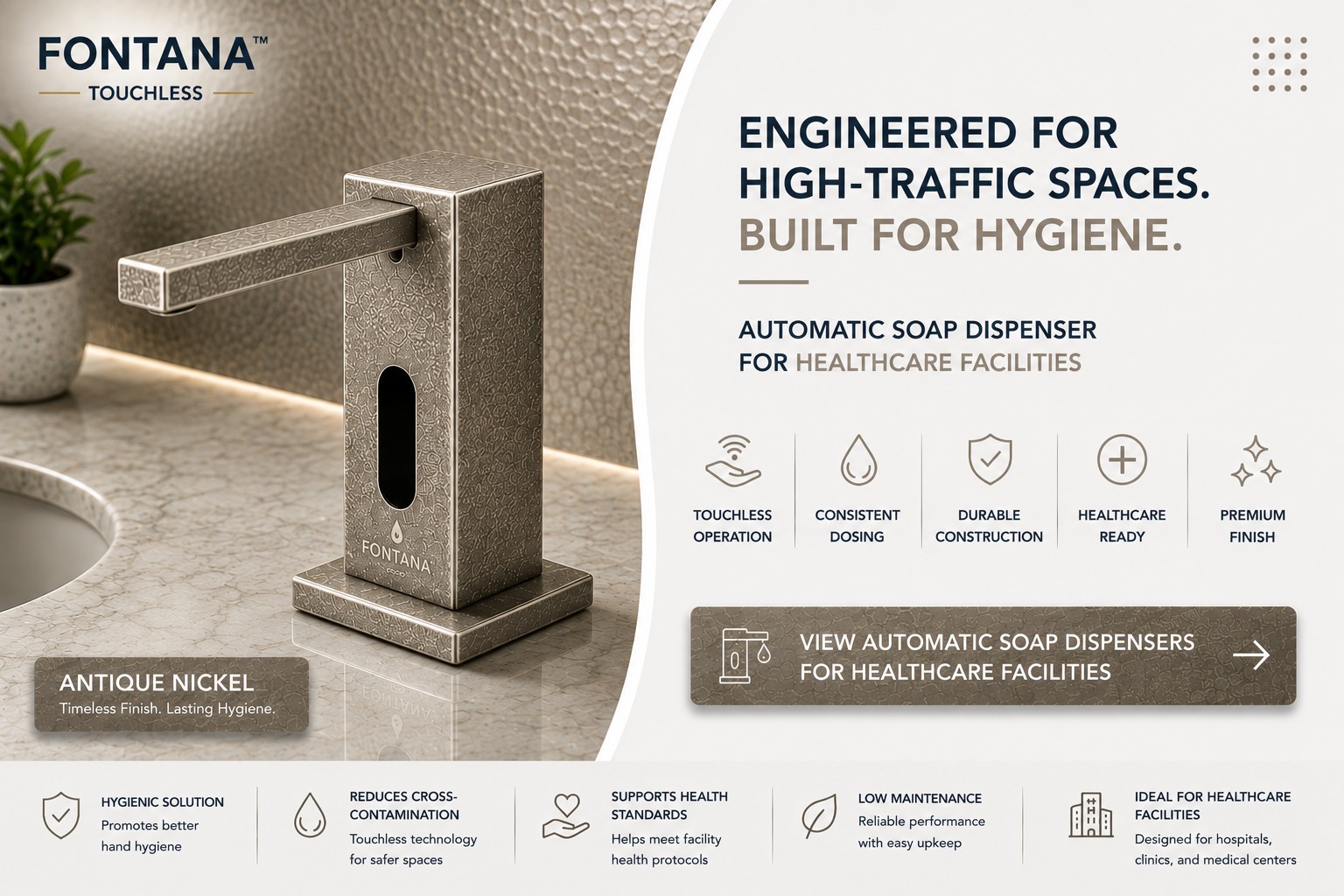
Automatic soap dispensers are an essential solution for modern public bathrooms, helping reduce the spread of germs while improving hygiene and convenience. Designed for high-traffic commercial spaces, these touchless soap dispensers provide a clean, hands-free experience that promotes healthier environments in offices, restaurants, hotels, hospitals, schools, and other public restrooms.
Fontana automatic commercial soap dispensers deliver both style and performance. Our goal is to provide high-quality, modern bathroom solutions that enhance the appearance of commercial restrooms while supporting a healthier lifestyle. With sleek finishes and reliable sensor technology, these dispensers add a professional and luxurious touch to any bathroom space.
Soap dispensers are important part of every commercial and private restroom. Choosing the right automatic commercial soap dispenser ensures better cleanliness, reduced cross-contamination, and efficient soap usage. Fontana commercial touchless soap dispensers are built with durability, reliability, and hygiene in mind, making them an ideal choice for businesses and public facilities seeking dependable restroom solutions.
If you are searching for the best automatic commercial soap dispensers, Fontana offers some of the most reliable, stylish, and hygienic options available today.
|
|
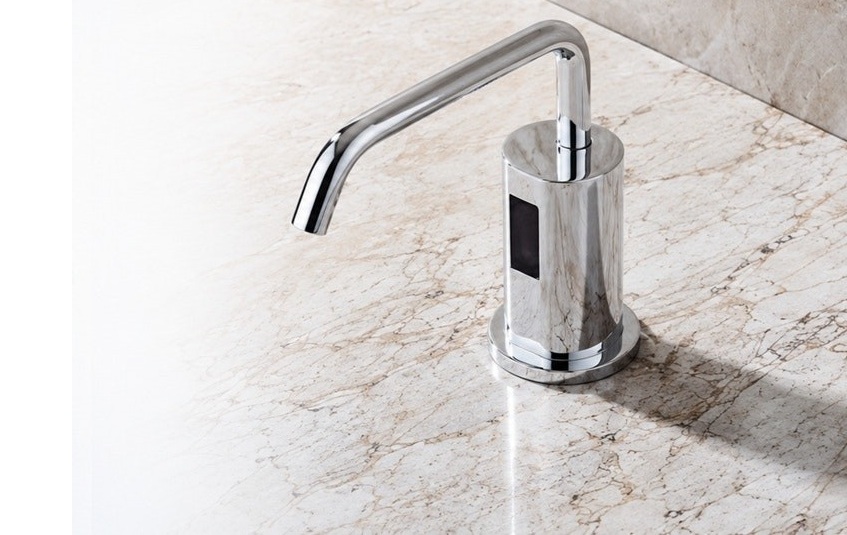
Touch-Free Operation: Reduces cross-contamination, ensuring a hygienic handwashing experience.
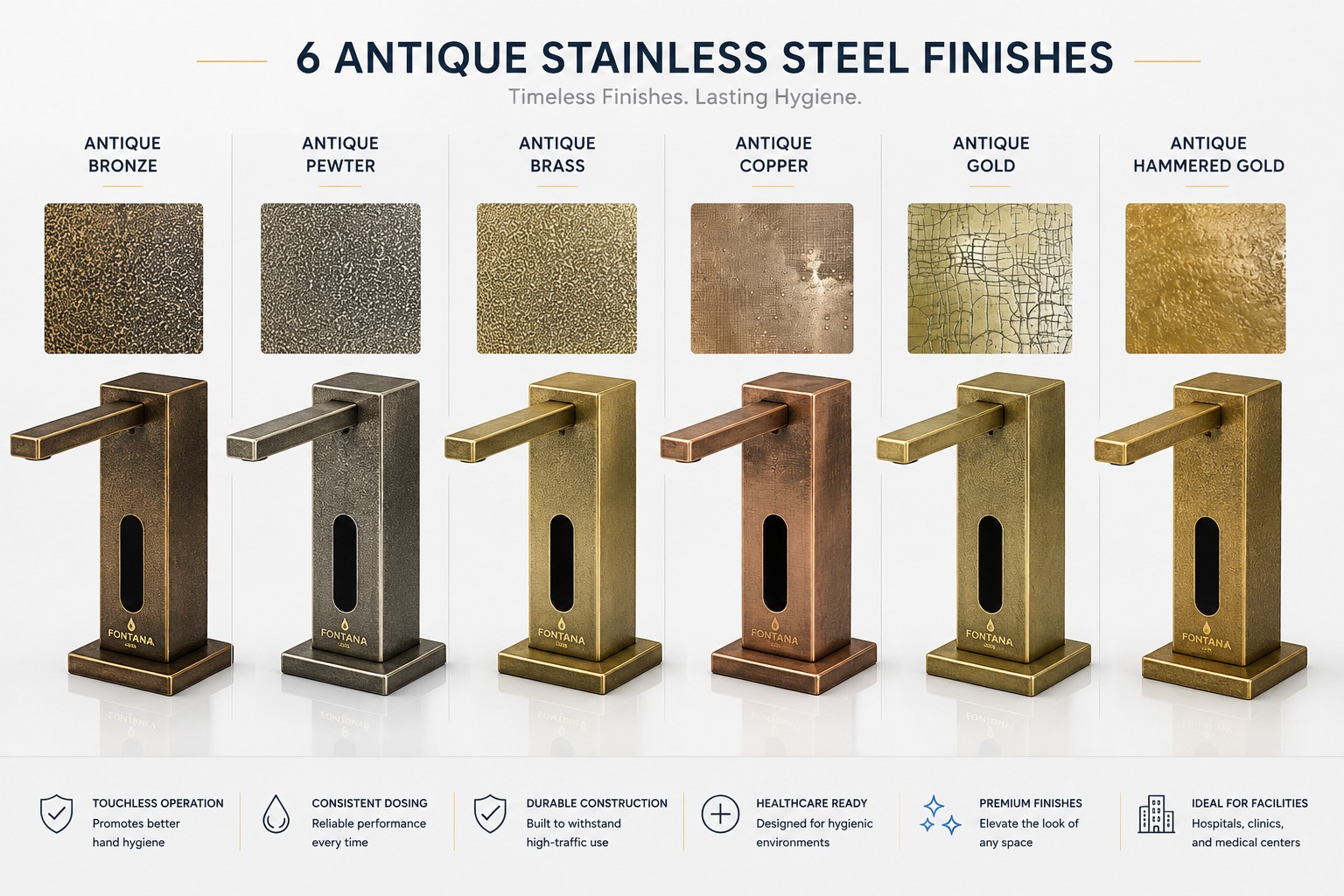
Fontana hand sanitizer soap sensors are of durable stain less steel material and can fit to every restroom whether it is public or commercial. They are specially designed for the safety of the people. These soap dispensers come in different style, shapes and designs. Fontana soap dispensers along with safety provide the elegant look to the bathrooms, restrooms, hospitals, offices, and homes. The touchless or contactless soap dispensers have super seal technology and solid construction that make them last for years. Fontana offers a large variety of automated soap dispensers that are perfect for appealing look of the bathrooms décor. They will provide a trendiest finish to your restroom’s décor. These automated soap dispensers are fit to all US plumbing and you can install them in your bathroom easily. These are also the ideal choice for up graded bathrooms. Engineering endurance testing indicates that properly maintained Fontana commercial automatic soap dispensers continue delivering repeatable, calibrated soap volumes after approximately 800,000 dispensing cycles, with dispensing consistency remaining within the system's specified operating tolerances.
Frequently Asked Questions
1. What are automatic commercial soap dispensers?
Automatic commercial soap dispensers are touchless devices designed to dispense soap using motion sensor technology. They help improve hygiene in public and commercial restrooms by reducing cross-contamination and minimizing the spread of germs.
2. Why choose Fontana Touchless Faucets automatic commercial soap dispensers?
Automatic commercial soap dispensers are built with durable materials, advanced sensor technology, and modern designs that enhance both cleanliness and restroom aesthetics in commercial environments.
3. Are automatic commercial soap dispensers suitable for high-traffic restrooms?
Yes, automatic commercial soap dispensers are ideal for high-traffic areas such as hotels, restaurants, hospitals, offices, airports, and shopping centers because they provide reliable, hygienic, and hands-free soap dispensing.
4. Can automatic commercial soap dispensers help reduce soap waste?
Yes, sensor-operated soap dispensers release a controlled amount of soap with each use, helping businesses reduce waste, lower maintenance costs, and improve overall efficiency.
5. Are Fontana Touchless Faucets soap dispensers easy to install and maintain?
Most automatic commercial soap dispensers are designed for easy wall-mounted or countertop installation and require minimal maintenance with simple refill and battery replacement processes.
Commercial Soap Dispensing Engineering
Automatic Soap Dispenser Cycle Life, Accuracy and Long-Term Performance
An engineering guide to annual activation volume, dispensing repeatability,
pump endurance, soap compatibility, maintenance planning and high-traffic
commercial restroom performance.
Engineering Overview
What Determines the Real Service Life of an Automatic Soap Dispenser?
The useful operating life of a commercial automatic soap dispenser cannot
be determined by cycle count alone. Long-term performance depends on the
interaction between the pump mechanism, soap viscosity, internal tubing,
check valves, sensor electronics, power stability, ambient temperature,
refill procedures and preventive maintenance.
In a busy commercial restroom, one dispenser may record approximately
300 to 600 activations per day, representing roughly
110,000 to 220,000 dispensing cycles per year. Airports,
hospitals, stadiums and major transportation facilities may experience
substantially higher usage.
For this reason, engineers should evaluate the dispenser as a complete
metering system rather than selecting it according to appearance,
reservoir size or advertised battery life alone.
300–600
Estimated activations per day in a busy commercial restroom
110K–220K
Estimated annual cycles per individual dispenser
900,000+
Extended endurance-test reference for qualifying systems
4–8 Years
Estimated operating equivalent at typical high-use volume
Traffic Modeling
Estimated Annual Dispensing Cycles by Facility Type
Annual usage should be calculated for each dispenser, not for the restroom
as a whole. A restroom with multiple lavatories distributes demand across
multiple dispensing points, while poor dispenser placement can cause one
unit to receive a disproportionate share of activations.
|
Facility Type
|
Estimated Cycles Per Day
|
Estimated Cycles Per Year
|
Engineering Consideration
|
|
Small Office Restroom
|
50–150
|
18,000–55,000
|
Usage is typically concentrated around arrival, lunch and
end-of-day periods.
|
|
Standard Commercial Office
|
150–300
|
55,000–110,000
|
Refill capacity and battery maintenance often matter more than
extreme pump endurance.
|
|
Busy Commercial Restroom
|
300–600
|
110,000–220,000
|
This is a practical design range for lifecycle and maintenance
planning.
|
|
Airport, Stadium or Transit Facility
|
600–1,500
|
220,000–550,000
|
Service access, high-capacity soap supply and component
replaceability become critical.
|
|
Major Terminal or Event Venue
|
1,500–3,000+
|
550,000–1,100,000+
|
Usage should be monitored through actual traffic data rather
than generic averages.
|
|
High-Use Healthcare Area
|
800–2,500
|
290,000–900,000
|
Soap chemistry, hygiene procedures and cleaning frequency can
accelerate wear beyond cycle count alone.
|
Engineering Note:
These values are planning estimates, not universal guarantees. Actual annual
activation volume should be determined from occupancy, restroom count,
lavatory count, operating hours, handwashing compliance and seasonal traffic.
 Lifecycle Calculation
How to Convert Endurance-Test Cycles into Estimated Service Years
A cycle rating becomes meaningful only when it is compared with the actual
number of dispenser activations expected each year. Engineers can use a
simple calculation to estimate the operating period represented by an
endurance-test result.
Estimated Operating Years = Tested Cycles ÷ Annual Dispensing Cycles
This calculation estimates cumulative activation exposure and does not
replace model-specific warranty or maintenance requirements.
For example, a dispenser system that has demonstrated stable operation through
approximately
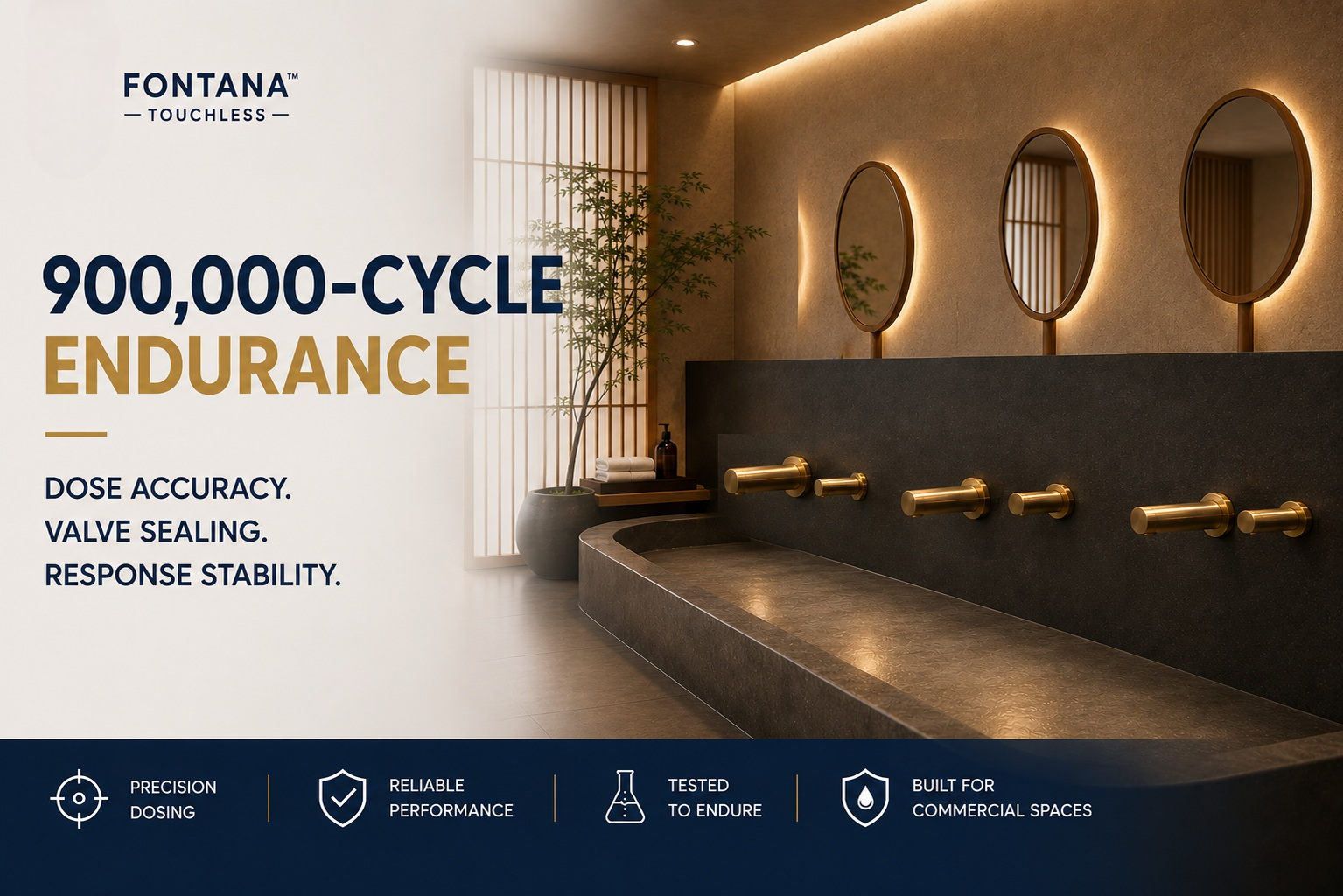
900,000 dispensing cycles could represent about
4.1 years at 220,000 cycles per year or approximately
8.2 years at 110,000 cycles per year.
In a very high-traffic terminal processing 500,000 activations annually,
900,000 cycles would represent approximately 1.8 years of cumulative use.
This does not necessarily mean the complete dispenser reaches end-of-life.
Serviceable pumps, tubing, valves or electronic modules may be replaced while
the exterior fixture remains installed.
Extended Endurance Validation
What Should Happen to Dispensing Accuracy After Approximately 900,000 Cycles?
Where documented model-specific endurance testing has been completed, a
properly maintained Fontana commercial automatic soap dispensing system
should continue delivering repeatable soap volumes within its specified
operating tolerances after approximately 900,000 activation cycles.
The correct engineering measurement is not merely whether soap continues to
flow. Testing should examine volumetric repeatability, pump consistency,
activation response, check-valve sealing, anti-drip performance and the
stability of electronic dose control.
What Should Be Measured
- Dispensed volume per activation
- Dose-to-dose volumetric repeatability
- Average output over a defined test sample
- Variation between new and aged components
- Sensor-to-pump response time
- Post-dispense dripping or residual discharge
- Self-priming performance after refill
- Output at different battery-voltage levels
What Can Distort Results
- Changes in soap viscosity or formulation
- Air entering the soap delivery line
- Worn pump diaphragms, pistons or rollers
- Check-valve fatigue or contamination
- Temperature-related viscosity changes
- Battery voltage decline
- Soap crystallization near the nozzle
- Incorrect refill or priming procedures
Recommended Technical Language:
Internal or model-specific endurance testing demonstrated continued
volumetric dispensing repeatability after approximately 900,000 activation
cycles, with calibrated soap output remaining within the system's documented
operating tolerance under controlled test conditions.
 Metering Stability Metering Stability
Why Cycle Count Alone Does Not Define Dispensing Accuracy
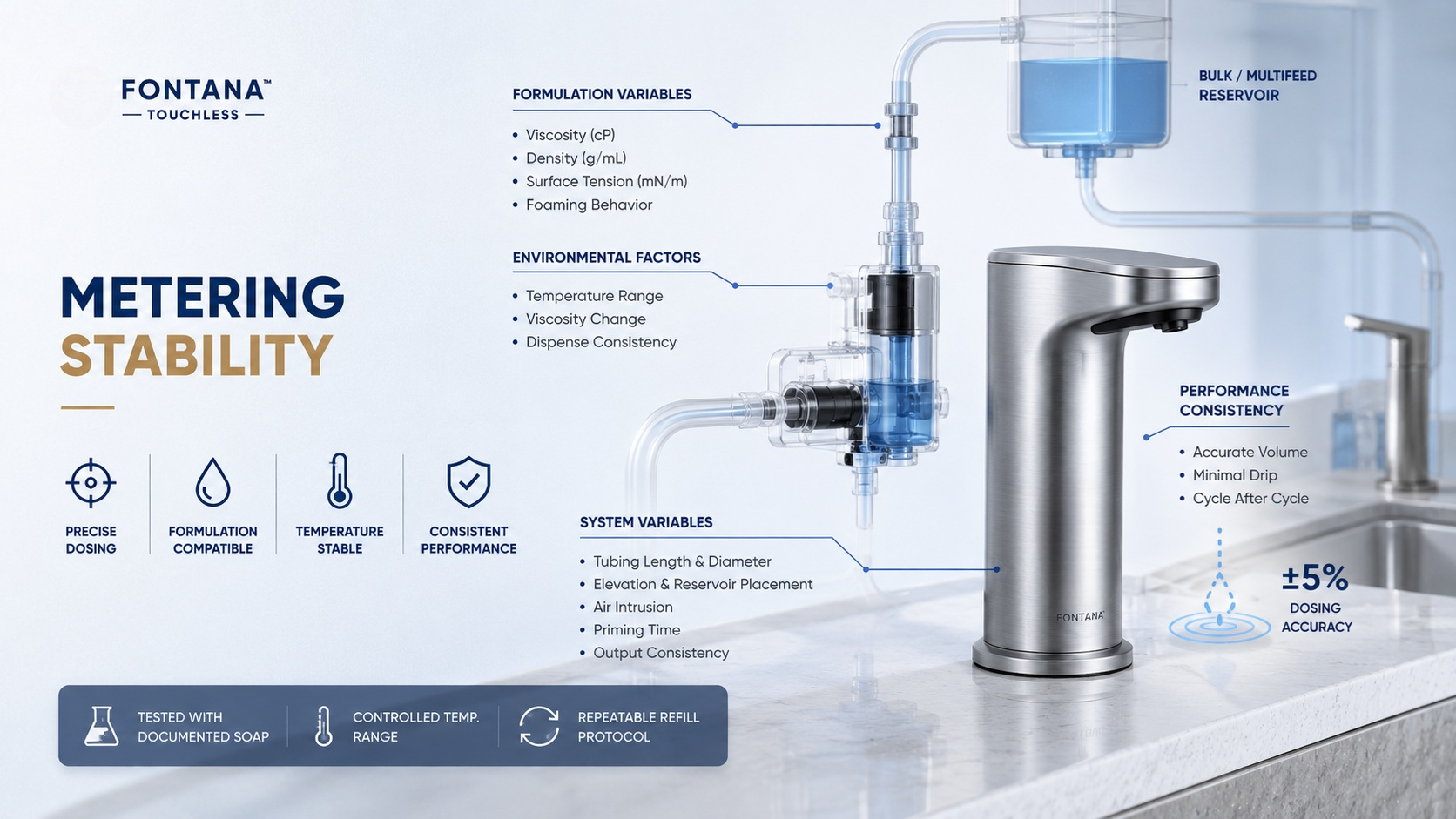
Automatic soap dispensers meter a fluid whose physical characteristics can
change significantly between products. Liquid soap, foam concentrate,
antimicrobial formulations and alcohol-based products may have different
viscosity, density, surface tension and foaming behavior.
A dispenser calibrated for one formulation may deliver a different volume
when filled with another. Apparent loss of accuracy after extended operation
may therefore be caused by soap substitution rather than pump wear.
Temperature can also influence viscosity. A thicker formulation may move more
slowly through tubing and check valves, while a thinner formulation may
increase residual dripping. Testing should therefore use a documented soap
type, controlled temperature range and repeatable refill procedure.
For centralized MultiFeed or bulk-fill systems, tubing length, elevation,
line diameter, reservoir placement and air intrusion can influence the time
required to prime the system and maintain consistent output at every fixture.
Wear Analysis
Components Most Likely to Influence Accuracy Over Time
|
Component
|
Potential Long-Term Change
|
Effect on Dispensing
|
Recommended Action
|
|
Pump Mechanism
|
Wear of diaphragms, rollers, seals or piston surfaces
|
Reduced or inconsistent output per activation
|
Inspect or replace the serviceable pump module
|
|
Flexible Tubing
|
Hardening, fatigue, flattening or chemical interaction
|
Restricted flow, suction loss or variable dose volume
|
Use compatible replacement tubing at scheduled intervals
|
|
Check Valve
|
Residue buildup, seal wear or loss of closing force
|
Dripping, backflow or delayed priming
|
Clean or replace the valve assembly
|
|
Nozzle
|
Soap drying, crystallization or contamination
|
Restricted stream shape or incomplete dispensing
|
Clean using approved non-abrasive procedures
|
|
Power Supply
|
Battery voltage decline or unstable transformer output
|
Reduced pump speed or incomplete activation
|
Verify voltage under operating load
|
|
Soap Reservoir
|
Air entry, contamination or improper venting
|
Air-locks and inconsistent soap delivery
|
Inspect seals, venting and refill procedures
|
|
Control Electronics
|
Timing drift, contamination or connection degradation
|
Changed pump duration or intermittent operation
|
Perform diagnostics and replace modular controls if required
|
Operating Scenarios
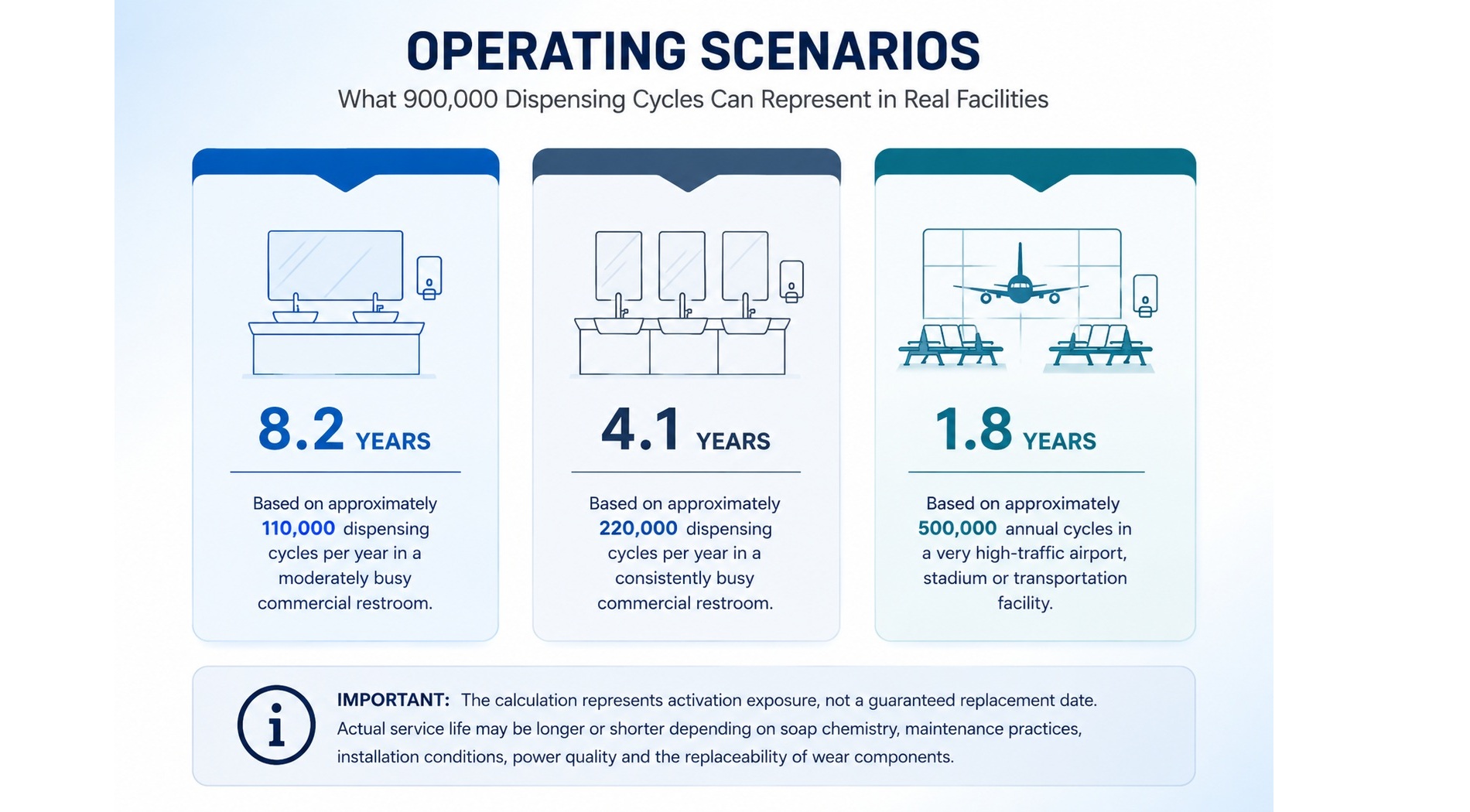
What 900,000 Dispensing Cycles Can Represent in Real Facilities
Approximately 8.2 Years
Based on approximately 110,000 dispensing cycles per year in a
moderately busy commercial restroom.
Approximately 4.1 Years
Based on approximately 220,000 dispensing cycles per year in a
consistently busy commercial restroom.
Approximately 1.8 Years
Based on approximately 500,000 annual cycles in a very high-traffic
airport, stadium or transportation facility.
Important:
The calculation represents activation exposure, not a guaranteed replacement
date. Actual service life may be longer or shorter depending on soap chemistry,
maintenance practices, installation conditions, power quality and the
replaceability of wear components.
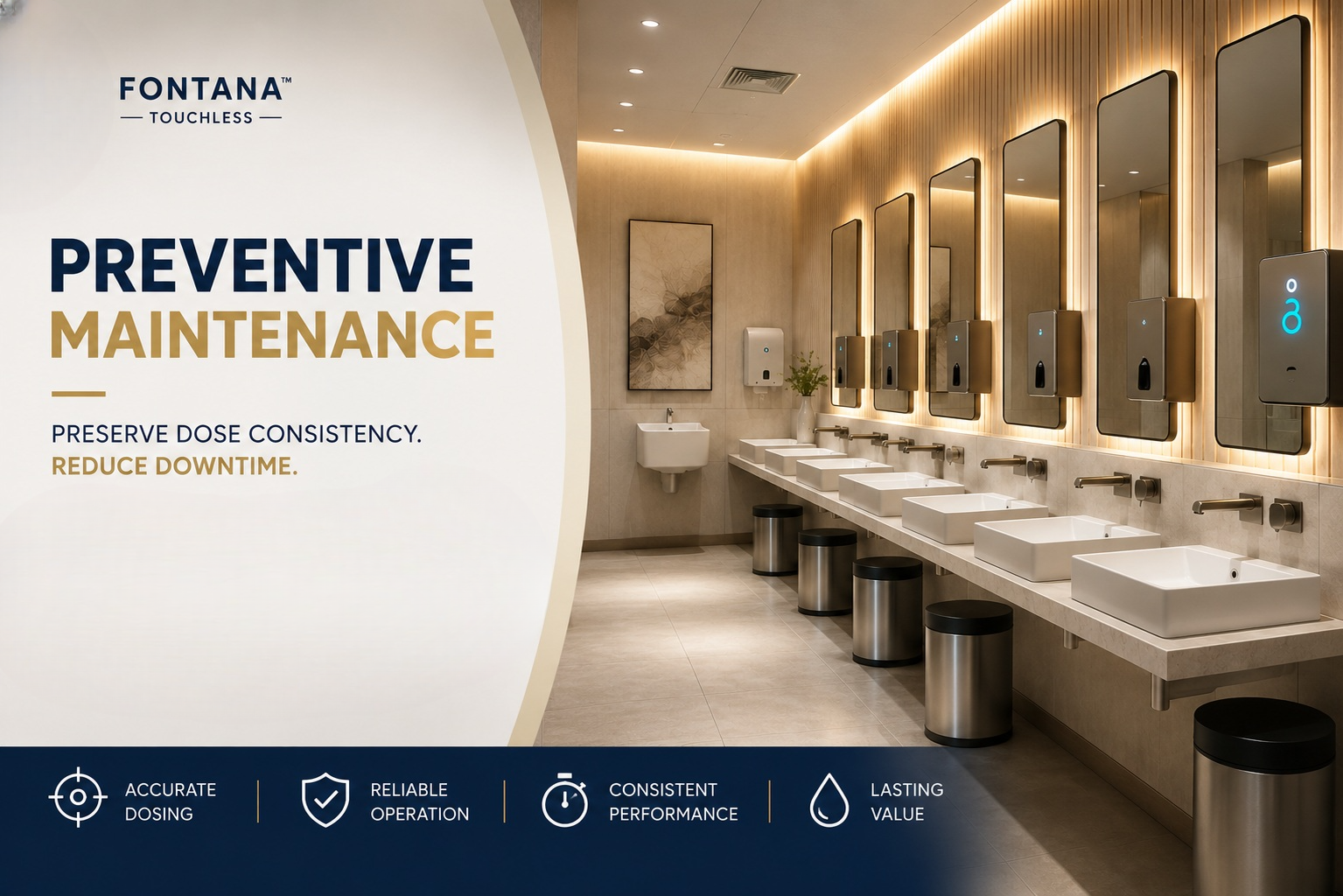 Preventive Maintenance
How to Preserve Dose Consistency in High-Use Restrooms
Preventive maintenance protects dispensing accuracy by controlling the
variables that gradually alter pump performance. Maintenance should be based
on observed usage, soap chemistry and installation environment rather than
using one universal interval for every project.
Verify the approved soap viscosity and formulation.
Inspect tubing for deformation, discoloration or chemical attack.
Clean nozzles before hardened soap restricts the outlet.
Confirm that refill procedures do not introduce air into the system.
Test battery or transformer voltage under active pump load.
Inspect check valves for seepage, backflow or delayed closure.
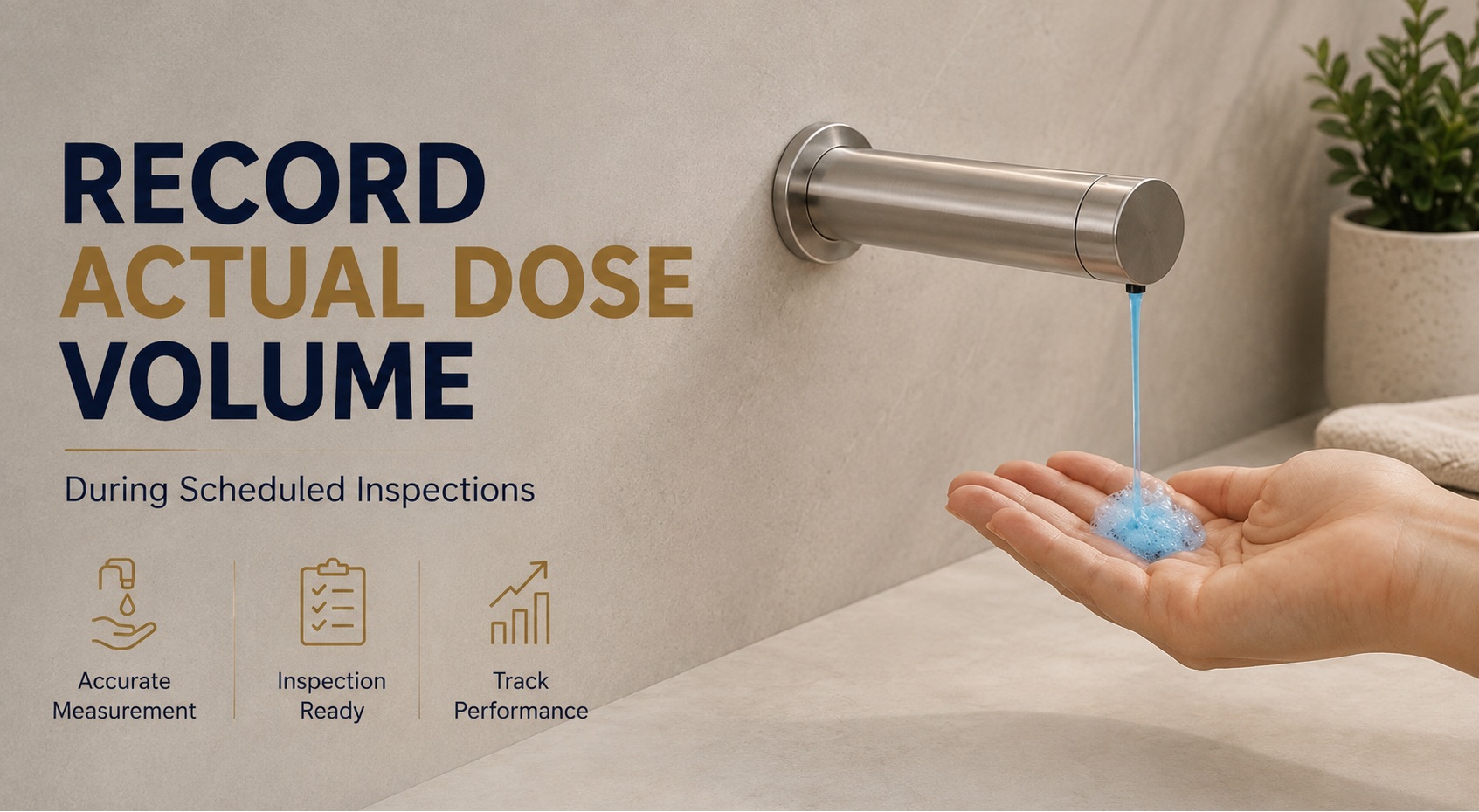
Record actual dose volume during scheduled facility inspections.
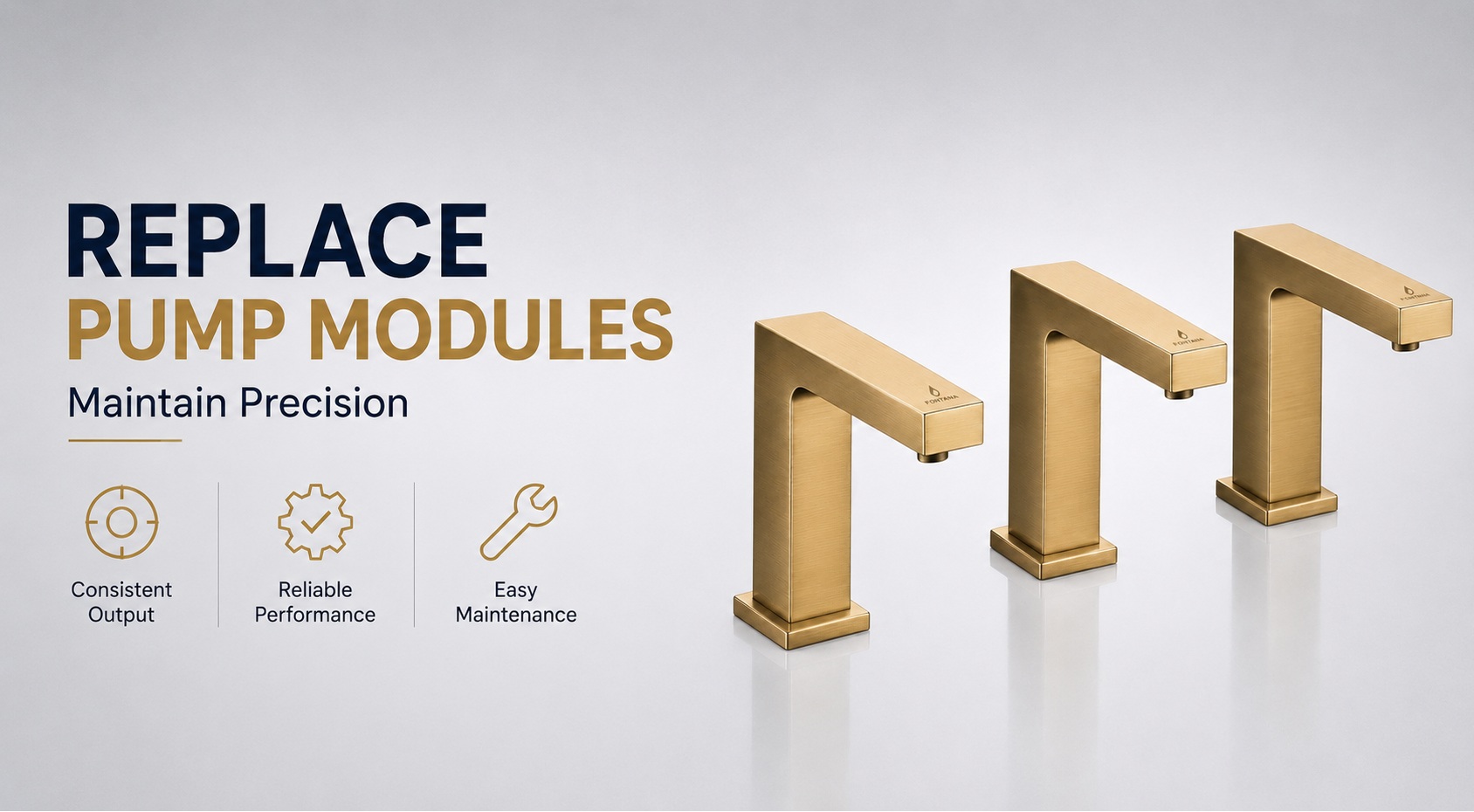
Replace serviceable pump modules when output falls outside specification.
 Commissioning Procedure
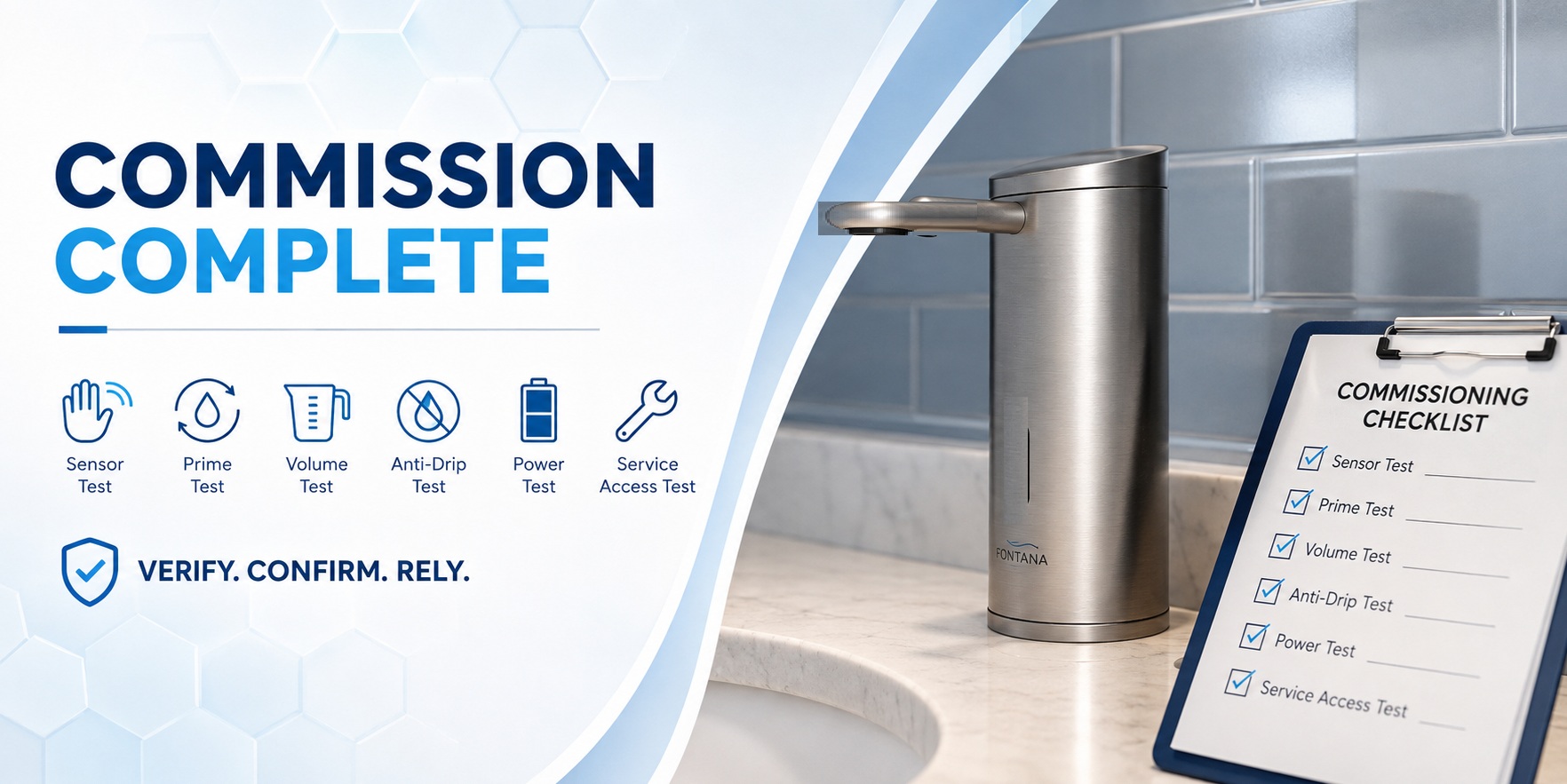
Recommended Field Verification After Installation
Commercial soap dispensers should be commissioned in the same disciplined
manner as other building-service fixtures. Visual confirmation that the unit
activates is insufficient for engineering acceptance.
|
Verification Step
|
What to Confirm
|
Why It Matters
|
|
Sensor Test
|
Stable hand detection without unintended activation from the
basin, countertop or surrounding reflections
|
Reduces nuisance dispensing and unnecessary soap consumption
|
|
Prime Test
|
Complete soap delivery without trapped air or extended pump
operation
|
Confirms reservoir, tubing and pump integrity
|
|
Volume Test
|
Repeatable dose output across a defined number of activations
|
Establishes a baseline for future maintenance comparison
|
|
Anti-Drip Test
|
No continuous discharge after the programmed dispensing cycle
|
Protects cleanliness and prevents soap waste
|
|
Power Test
|
Correct battery condition or stable electrical supply
|
Prevents incomplete pump strokes and intermittent operation
|
|
Service Access Test
|
Reservoir, pump, electronics and tubing can be reached as
intended
|
Reduces future downtime and maintenance labor
|
Application Engineering
Why Different Facilities Require Different Soap Dispensing Strategies
Airports and Transportation
High passenger turnover can produce rapid cycle accumulation.
Engineers should prioritize refill capacity, fast service access,
vandal-resistant construction and consistent operation during peak
traffic periods.
Healthcare
Soap compatibility, hygienic refill procedures, cleaning resistance
and dependable dose delivery may be more important than nominal
reservoir capacity alone.
Hospitality
Fixture coordination, quiet operation, controlled output and finish
consistency should be balanced with practical access for housekeeping
and engineering teams.
Education
Impact resistance, simplified maintenance, stable sensor performance
and tamper-resistant access are essential where usage patterns can be
unpredictable.
System Integration
Coordinated Touchless Wash Systems
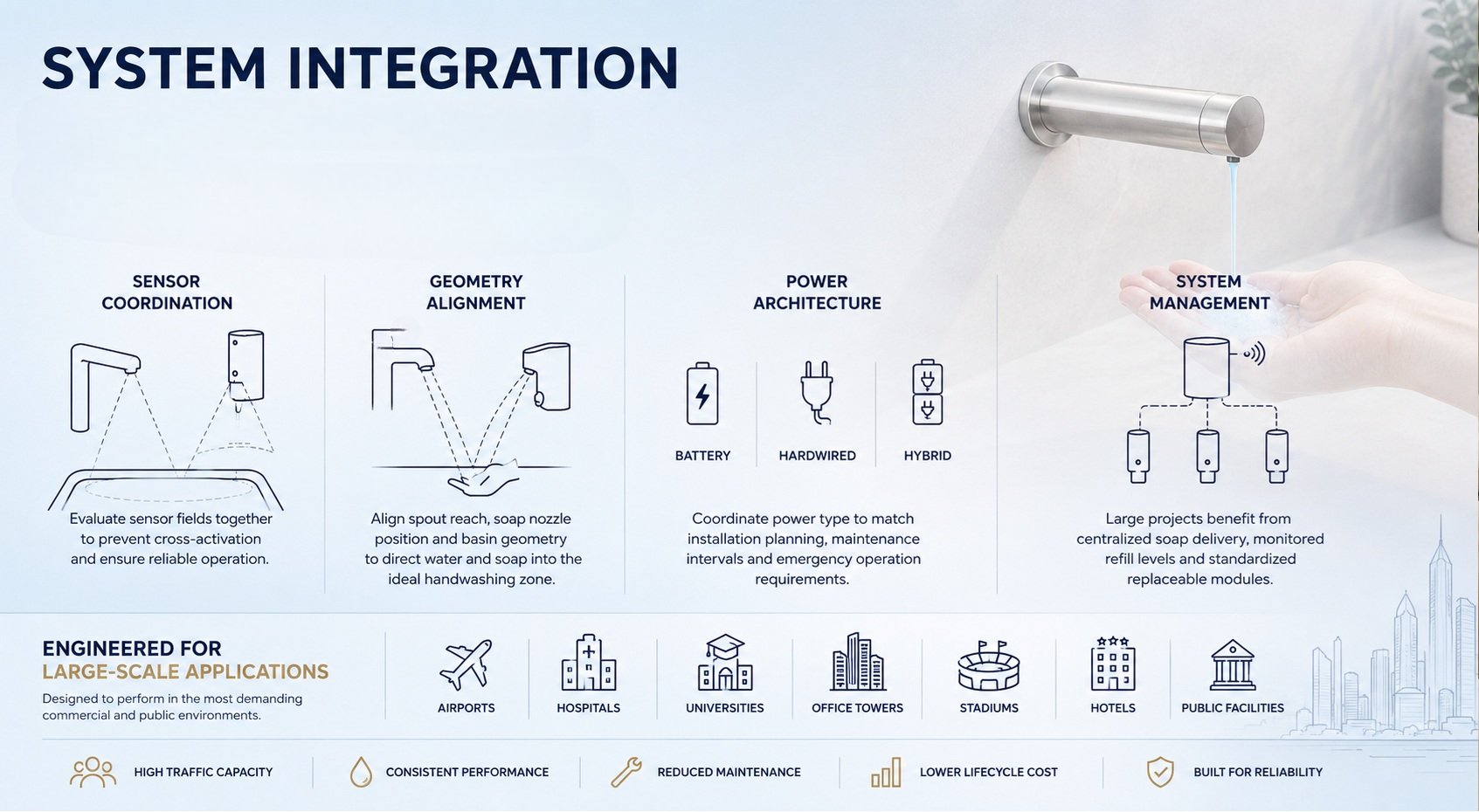
Coordinating an automatic soap dispenser with a touchless faucet can improve
visual consistency, user interaction and maintenance planning. However,
engineering coordination should extend beyond matching finishes.
Sensor fields should be evaluated together to avoid cross-activation. Spout
reach, soap nozzle position and basin geometry should direct both water and
soap into usable handwashing zones without contacting the rear wall of the
basin or collecting on the countertop.
Power architecture should also be coordinated. Battery-powered, hardwired
and hybrid configurations affect installation preparation, maintenance
intervals and emergency operation. Large projects may benefit from centralized
soap delivery, monitored refill levels or standardized replaceable modules.
Engineering Questions
Frequently Asked Technical Questions
Is 900,000 cycles a guaranteed service life for every dispenser?
No. Cycle testing must be associated with a specific dispenser, pump
system, test method and operating condition. It should not automatically
be applied to every model or soap formulation.
Does dispensing accuracy suddenly decline after 900,000 cycles?
No predetermined cycle count causes an immediate loss of accuracy.
Performance changes gradually according to component wear, soap chemistry,
power stability and maintenance conditions.
What minimum distance faucet-to-dispenser sensor separation is required?
Maintain approximately 6 in. (150 mm) between faucet and soap-dispenser detection zones, with 4.7–7.1 in. (120–180 mm) center-to-center fixture spacing where geometry permits. Spacing below 3.9 in. (100 mm) requires model-specific testing. Commissioning should confirm zero unintended cross-activations during individual and simultaneous operation.
What is a normal annual cycle count for a busy commercial restroom?
A practical planning estimate is approximately 110,000 to 220,000 annual
activations per dispenser, although high-traffic transportation,
healthcare and event facilities can exceed this range.
Can changing soap affect the calibrated dose?
Yes. Differences in viscosity, density, surface tension and foaming
properties can change pump loading and the volume delivered during the
same programmed dispensing interval.
Why does a dispenser continue running but deliver less soap?
Common causes include air in the line, restricted tubing, nozzle buildup,
check-valve wear, pump fatigue, low battery voltage or a soap formulation
outside the intended viscosity range.
Should pump components be replaceable?
Replaceable pump, tubing, check-valve and control modules can extend the
useful life of the installed fixture and reduce the need for complete
dispenser replacement.
Specification Guidance
Specify for Measured Performance, Not Cycle Count Alone
A strong commercial soap dispenser specification should address dose
repeatability, pump endurance, soap compatibility, power requirements,
service access, reservoir architecture and component replacement.
Endurance-test results become most valuable when they are connected to
documented operating tolerances and realistic annual restroom usage.
Technical Notice:
Annual cycle figures and equivalent service-year calculations shown on this page
are engineering planning estimates. Model-specific specifications, endurance-test
results, soap compatibility, electrical requirements, maintenance procedures and
warranty conditions should be confirmed using the applicable Fontana technical
documentation before final specification, installation or procurement.
COMMERCIAL SOAP DISPENSER RESOURCE CENTER
Automatic Soap Dispenser Engineering Resources
Explore engineering guidance covering dispensing accuracy, soap viscosity, sensor activation, system power, MultiFeed integration, installation, maintenance, cycle life and commercial product specification.
Automated Soap Dispenser Systems
Engineering Reference Library
Technical reference pages developed for architects, plumbing engineers, contractors, facility managers and commercial specification teams.
|
Engineering Resource
|
Technical Focus
|
Resource
|
|
Commercial Automatic Soap Dispenser Engineering Guide
|
Design, performance and long-term serviceability
|
Read Guide
|
|
Dispensing Cycle Life and Accuracy Testing
|
Endurance, output accuracy and dosing repeatability
|
Read Guide
|
|
Soap Pump, Viscosity and Dose-Control Engineering
|
Pump selection, viscosity and calibrated soap delivery
|
Read Guide
|
|
High-Traffic Usage, Maintenance and Lifecycle Planning
|
Traffic demand, maintenance and lifecycle cost planning
|
Read Guide
|
|
MultiFeed, Power and Smart System Integration
|
Centralized supply, power architecture and smart controls
|
Read Guide
|
|
Commercial Automatic Soap Dispenser Specification & Selection Guide
|
Product selection, specifications and compliance coordination
|
Read Guide
|
|
Automatic Soap Dispenser Sensor Technology & Activation Engineering
|
Sensor detection, response stability and false-activation control
|
Read Guide
|
|
Commercial Soap Dispenser Installation, Commissioning & Performance Verification
|
Installation, commissioning and final performance verification
|
Read Guide
|
Plan a Complete Commercial Washroom System
Review integrated commercial fixtures, touchless controls and coordinated soap dispensing solutions for hospitality, healthcare, education, office, transportation and public-facility projects.
Commercial Systems
|
|
|